The class develops what one-pedal driving is in electric vehicles, the risk of accidents, and the implications for fleet management.
Slide 2. The risks and measures of one-pedal driving.
- One-pedal driving.
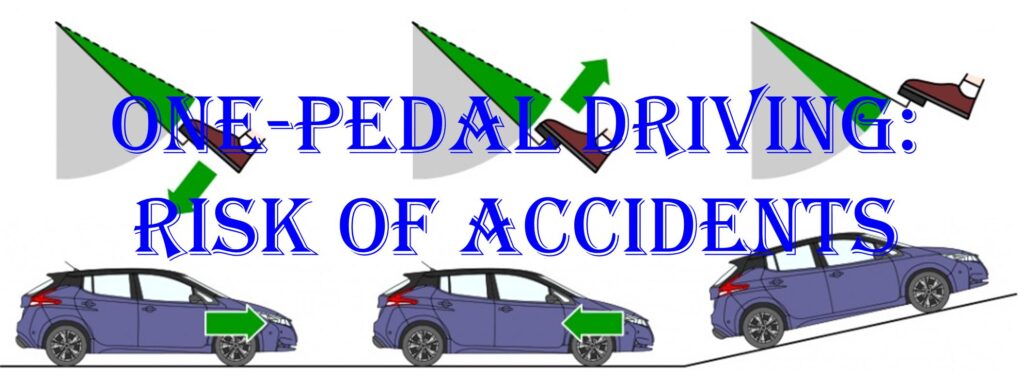
One of the advantages of electric cars is that they make little use of their brakes. Regenerative braking, which converts a car’s kinetic energy into electrical energy to charge the battery, is so powerful that it is often not even necessary to touch the brake pedal to stop the car. In practice, it is a very powerful engine brake that allows you to drive without touching the brake pedal, using only the accelerator.
One-pedal driving is not a new technology, as it has been available in some models on the market for years.
The BMW i3, for example, was one of the first to incorporate it and also to bring it to a wider audience, but Ford, Volkswagen, Hyundai, and Kia, among other brands, also have this interesting system in their electric range.
One of the most important things is that driving in one-pedal mode does not mean abandoning the conventional brake pedal. It will still be there and fulfilling its purpose.
In any case, the aim of this technology is to achieve greater deceleration with slight movements of the foot on the accelerator. In other words, if we stop accelerating, we will feel something similar to the engine brake of a combustion engine car. Imagine the sensation of shifting down a gear in a manual transmission.
Everything will depend on the level chosen in the car, whose activation and management varies from one model to another. You can find it, for example, in the form of paddles located behind the steering wheel, which will allow the system to retain more or less when you stop accelerating.
At first, it takes some getting used to, as it is normal for a driver to release the accelerator and move their right foot to the brake to decelerate. With this technology activated, which can have up to three different modes, it is possible to bring the vehicle to a complete stop in the highest retention mode.
That does not mean that we can forget about the conventional brake, as it will continue to be vital for emergency braking.
One-pedal driving should be thought of as a way to achieve smooth driving, even if it seems the opposite during the first few minutes of use. In addition, this technology is a very important ally in energy recovery.
In fact, it promotes timely recharging of the vehicle’s electric battery thanks to more efficient accumulation of the energy released during the deceleration process, which would otherwise be lost to a greater extent.
With this one-pedal driving mode, the rear lights come on if the pedal is released abruptly, as this is interpreted as braking, and it is important to warn vehicles behind of this maneuver.
It should be noted that its use is especially designed for urban areas or low speeds, as for highways there are already other technologies such as cruise control and many other driving assistance systems, including autonomous driving up to level 2, which is permitted in Spain.
- Risks of one-pedal driving.
One-pedal driving can increase the risk of accidents, as explained below.
- Safety issues arise when this braking is so powerful that it surprises the driver and the car behind, which sees the electric car in front suddenly slow down, often without the vehicle turning on its brake lights, which can lead to rear-end collisions.
- In situations requiring sudden braking, drivers accustomed to one-pedal driving may not react quickly enough to switch to the brake pedal, increasing the risk of accidents by increasing the braking distance and the risk of collision.
- One-pedal deceleration may not be as effective as traditional braking in emergency situations or on slippery roads, which could result in loss of vehicle control.
- The possibility of making a pedal error, confusing the accelerator with the brake, may also increase with one-pedal driving, especially if the driver is not completely familiar with the system.
- Chinese GB 21670-2025 standard.
The greater presence of electric cars in China compared to Europe has drawn the attention of the Chinese authorities to this problem. They have responded quickly by creating the GB 21670-2025 standard, which has been approved by the State Administration for Market Regulation and Standardization of China.
This new regulation, which will come into force on January 1, 2026, for newly approved vehicles and on January 1, 2027, for those already approved, puts China ahead of Europe in terms of legislating one-pedal driving technology in two very specific areas:
This regulation requires manufacturers selling electric cars in China, even foreign ones, to ensure that one-pedal driving technology does not activate automatically when the vehicle is started, but must always be activated manually by the driver. In this way, China wants to prevent drivers, whether regular or occasional, from forgetting about this feature and being surprised when it activates.
On the other hand, this regulation also makes it mandatory for brake lights to turn on automatically when deceleration exceeds 1.3 meters per second. In addition, to alert drivers behind the vehicle operating with this technology, the lights must remain on until deceleration ends.
Finally, this standard also balances something in which Europe was far ahead of China. Now, starting in 2026, all cars sold in China must have ABS as standard; a measure that has been mandatory in Europe for years but in China, some vehicle manufacturers, especially the cheaper ones, continued to offer this device as an option.
Interestingly, Chinese brands are not the most convinced by one-pedal driving. Cars from brands such as MG and BYD have very weak regenerative braking when the accelerator pedal is released, but more pronounced braking when the brake pedal is pressed. XPeng is one of the brands that does offer models with one-pedal driving.
This new standard thus seems to give Chinese brands an advantage, forcing their Western rivals to eliminate a feature that can be seen as a commercial advantage. However, it should also be recognized that not all manufacturers consider one-pedal driving to be a positive thing and have not wanted to implement it in their cars because it is not natural.
Porsche did not do so with the Taycan, for example. “You step on the brake to slow down, which is a learned behavior and is authentic. The driver receives a consistent and predictable response.
Even Tesla itself seems to be backtracking on its desire to use one-pedal driving, having removed the requirement for one-pedal driving in some of its newer models, now giving users the option to choose
- Implications for fleet management.
The main consequence of one-pedal driving is an increase in risk and traffic accidents.
A traffic accident has very negative consequences due to the possible injuries to the driver, vehicle passengers, pedestrians, and cyclists.
In the case of the driver, it can result in time off work.
In addition to the cost of repairs and the time during which the vehicle cannot be used to provide the service.
If the risk of accidents or the number of accidents increases, the vehicle’s insurance will increase.
The following measures are recommended to reduce risk and accidents.
- Vehicle purchase.
It is important that one-pedal driving technology is a driving option and that the intensity of regenerative braking can be adjusted.
- Driver familiarization.
It is crucial that drivers become fully familiar with how one-pedal driving works and practice in different conditions to assess its effectiveness and safety, so it is essential to provide training before they use a vehicle with this technology for the first time.
- Traditional braking.
In emergency situations or on slippery roads, it is essential to use traditional braking to ensure fast and safe braking.
- Switching modes.
Some vehicles offer the option of switching between one-pedal driving and traditional driving. It is recommended to use both modes depending on traffic conditions and driver needs. One-pedal driving is recommended in urban environments.
- Ensure that the vehicle has traditional brakes.
It is important to remember that one-pedal driving does not completely replace the traditional braking system, which must always be available for emergency situations.
Slide 3. Thank you for your time.
The class has developed what one-pedal driving is in electric vehicles, the risk of accidents, and the implications for fleet management. See you soon.
Bibliography.
https://www.hibridosyelectricos.com/coches/tecnologia-one-pedal-arte-conducir-usando-unicamente-pedal-acelerador-no_72405_102.html
https://www.hibridosyelectricos.com/coches/china-por-delante-europa-regulara-esta-tecnologia-causa-problemas-seguridad-en-coches-electricos_81154_102.html
https://www.hibridosyelectricos.com/coches/otra-funcion-pedal-acelerador-coches-electricos-desconoces-te-hara-mas-facil-conducir-diario_80695_102.html
https://www.motorpasion.com/industria/para-elon-musk-conduccion-solo-pedal-forma-definitiva-conduccion-futuro-china-acaba-prohibir-todos-sus-coches-electricos
The price of the training is 250 euros.
The training is asynchronous online, you can do it at your own pace, whenever and from wherever you want, you set the schedule.
Classes are video recorded.
Start date: The training can be started whenever you want. Once payment is made, you have access to the training.
The training is in English, subtitles and syllabus avalaible.
Other subtitles and video syllabus available: Arabic, Chinese, French, German, Indonesian, Italian, Japanese, Korean, Persian, Portuguese, Russian, Spanish, Thai, Turkish, Vietnamese.
All syllabus has been developed by the teacher.
Fill out the following form to receive course information, or write an email to:
Contact.
- José Miguel Fernández Gómez.
- Email: info@advancedfleetmanagementconsulting.com
- Mobile phone: +34 678254874 Spain.
Course Features.
- The course is aimed at: managers, middle managers, fleet managers, any professional related to electric vehicles, and any company, organization, public administration that wants to switch to electric vehicles.
- Schedule: at your own pace, you set the schedule.
- Duration: 25 hours.
- Completion time: Once you have started the course you have 6 months to finish it.
- Materials: english slides and syllabus for each class in PDF.
- If you pass the course you get a certificate.
- Each class has a quiz to take.
- English language, subtitles and syllabus.
- Other subtitles and video syllabus available: Arabic, Chinese, French, German, Indonesian, Italian, Japanese, Korean, Persian, Portuguese, Russian, Spanish, Thai, Turkish, Vietnamese.
-
Start date: The course can be started whenever you want. Once payment is made, you have access to the course.
Price.
- 250 euros.
-
You can pay by bank transfer, credit card, or PayPal.
Goals.
- Know the most important aspects to take into account when electrifying a fleet of vehicles.
- Learn about electric vehicle technology.
- Know the polluting emissions that occur when a fleet of vehicles is electrified.
- Know what technologies are viable to electrify a fleet of vehicles.
- Learn about real cases of vehicle fleet electrification.
- Know the history of the electric vehicle.
Syllabus.
- History of electric vehicle.
- Battery electric vehicle.
- History of the lithium ion battery.
- Types of electric vehicle batteries.
- New electric vehicle battery materials.
- Other storage technologies of electric vehicle batteries.
- Battery components.
- Battery Management System-BMS.
- Fundamentals of the electric motor.
- Electric vehicle inverter: what it is and what it is used for.
- Battery degradation loss of autonomy.
- What is covered and not covered by the electric vehicle battery warranty.
- Battery passport.
- Battery fire of the electric vehicle.
- Causes, stages and risks of battery fire.
- Real cases of electric vehicle fire.
- Electric vehicle battery fire extinguishment.
- Measures to prevent, extinguish and control electric vehicle fires.
- Fire safety regulations for electric vehicle batteries.
- Impact of ambient temperature on battery performance.
- Which emmits more Co2, an electric car or a car with an internal combustion engine.
- The use of rare earth earths in the electric vehicle.
- Plug-in electric hybrids, a solution or an obstacle to electrify the vehicle fleet?.
- Fleet electrification with hydrogen vehicles.
- Cybersecurity of charging points.
- The theft of copper in electric vehicle chargers.
- Incidents at electric car charging points and their possible solutions.
- Batery swapping.
- The second life of the battery of the electric vehicle at Rome-Fiumicino Leonardo Da Vinci airport.
- The tires of electric vehicles.
- Electric vehicle, artificial intelligence, and electricity demand.
- The case of Hertz electrification.
- The case of Huaneng: The world’s first electrified and autonomous mining fleet.
- Consequences on the vehicle fleet of an electric vehicle brand going bankruptcy.
- E-fuels and synthetic fuels are not an alternative to decarbonize the vehicle fleet.
- How to avoid premature obsolescence of the fleet’s electric vehicles.
- Polluting emissions from brakes.
- Mileage manipulation to extinguish warranty early on electric vehicles.
- The importance of the electricity tariff in reducing electric vehicle costs.
- Electric vehicles cause more motion sickness than gasoline vehicles.
- Electric vehicle insurance and advanced driver assistance systems-ADAS.
- One-pedal driving Risk of accidents.
Training teacher.
José Miguel Fernández Gómez is the manager of Advanced Fleet Management Consulting, a consulting company specialized in vehicle fleet management and the owner of the fleet management channel on YouTube AdvancedfleetmanagementTube.
Since 2007 I have been working in fleet management consultancy and training for all types of companies, organizations and public administrations. With this course I want to make my experience and knowledge acquired during my work and academic career in this discipline available to my clients.
I carry out consulting projects related to vehicle fleet management and collaborate with companies developing products/services in this market. I have worked at INSEAD (France), one of the best business schools in the world, as a Research Fellow at the Social Innovation Centre-Humanitarian Research Group.
I carried out consulting and research activities in a project for the United Nations refugee organization (UNHCR), optimizing the size and management of the activities of the vehicle fleet, which this organization has distributed throughout the world (6,500 vehicles).
I worked as a fleet manager for five years, for Urbaser, which managed the street cleaning service in Madrid (Spain). I managed a fleet of 1,000 vehicles, made up of various technologies and types of vehicles such as: heavy and light vehicles, vans, passenger cars or sweepers.
I have completed all my academic degrees at the Polytechnic University of Madrid, one of the best universities in Spain, my academic training is as follows:
I hold a PhD in Industrial Engineering, with international mention, since I carried out research stays at the University of Liverpool (UK) and at the Royal Institute of Technology-KTH (Sweden).
I am also an Industrial Engineer (Industrial Management) and an Mechanical Engineer, and I completed a Master’s Degree in Operations Management, Quality and Technological Innovation (Cepade) and another Master’s Degree in Industrial Management (UPM).
I have publications in indexed magazines and presentations at international industrial engineering conferences.
Cancellations and penalties.
Once the course has started, the amount will not be refunded.