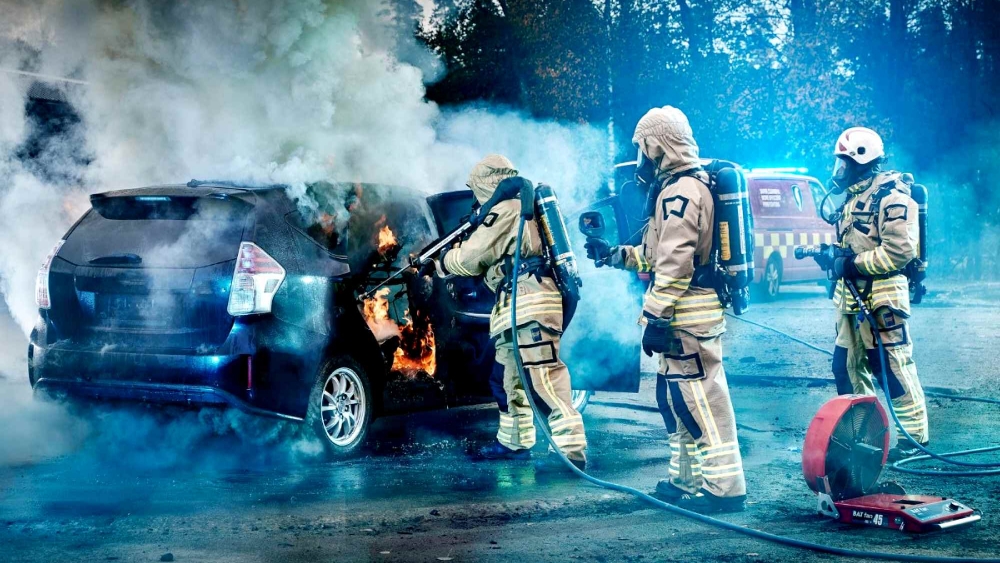
The Polish State Fire Service is categorical in its reports: the fire rate is identical between electric and combustion models.
Although there seems to have been a lull now, in 2025 there was a period when a series of electric car fires put society on alert. Fear began to spread and, as a result, parking was even banned in some places. However, how much of this is true and how much is not?
The Polish State Fire Service has shared a report with the data it has collected during its interventions, as reported by PSNM, and its conclusions are clear: of all vehicle-related fires in which it responded during the first half of the year, electric cars were responsible for less than 0.5%.
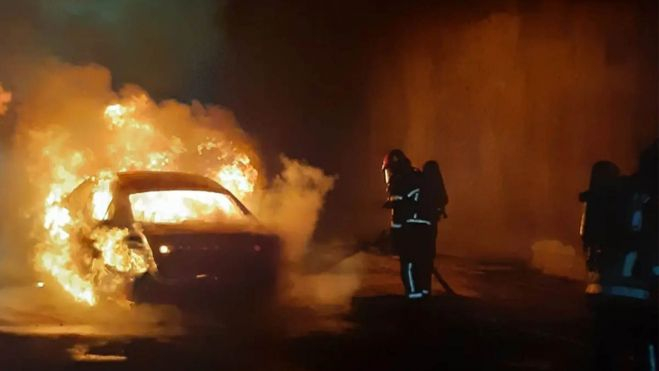
Although rare, fires involving electric vehicles are difficult to extinguish due to the presence of the battery.
Data on electric car fires is average
The headline in the fire department’s report is stark: fires involving combustion engine vehicles accounted for 98.39% of all incidents. However, this figure is somewhat unrealistic, given that electric car sales in Poland only accounted for 8% of the market, meaning that there are far fewer battery-powered vehicles than those equipped with combustion engines. Thus, between January and June, there were only 23 fires involving electric vehicles, compared to 4,636 involving combustion models and 53 involving hybrids and plug-in hybrids.
That is why we need to look at the relative data, i.e., the fire rate per 1,000 registered vehicles, as this is more accurate. This shows that 0.23 electric vehicles catch fire per 1,000 registered vehicles, exactly the same as combustion engine vehicles. In this regard, hybrids (HEVs and PHEVs) can boast a rate of 0.04 per 1,000 vehicles.
Albert Kania, from F5A New Mobility Research and Consulting, explains: “Although electric vehicle fires continue to attract media attention, the verified data does not support the claim that they are more dangerous than combustion engine vehicles. On the contrary, analysis of the causes shows that only 30% of fires were due to a fault or malfunction, and not all of them affected the high-voltage system. In more than half of the incidents (52%), the cause was defined as ‘other or unknown’, meaning that there is no clear evidence of a connection with the electric propulsion system or the battery.”
The firefighters’ point of view
Looking back, data has been collected in Poland since 2020. In this five-year period, there have been 50,833 fires involving combustion cars, 222 involving hybrids, and only 87 involving pure electric vehicles. As is logical, this is largely due to the sales volumes of each type.
Tomasz Jonio, brigadier general at the headquarters of the Polish State Fire Service, explains: “Fires involving alternative propulsion vehicles, such as ‘fully electric vehicles’ and hybrids, continue to generate a lot of controversy. In the media, almost all car fires are immediately described as ‘electric vehicle’ fires. Subsequent clarifications or corrections to the information no longer reach this audience. This creates a negative perception of the safety of battery electric vehicles (BEVs), and some firefighting communities rely on media reports.”
In addition, it adds some insight into why extinguishing electric vehicle fires takes longer, which, in addition to the nature of the fire itself, also has to do with the procedures performed by firefighters: “It should be noted that fires involving electric or hybrid vehicles take longer [to extinguish] than those involving conventional vehicles, but this is due to the provisions of the body’s principles of action, which require the temperature of the vehicle’s battery to be checked at specific intervals. This ensures the safety of operations for rescuers and the person in charge of the rescue operation, but also for the person or entity that takes charge of the damaged vehicle after a fire.”
The price of the training is 250 euros.
The training is asynchronous online, you can do it at your own pace, whenever and from wherever you want, you set the schedule.
Classes are video recorded.
Start date: The training can be started whenever you want. Once payment is made, you have access to the training.
The training is in English, subtitles and syllabus avalaible.
Other subtitles and video syllabus available: Arabic, Chinese, French, German, Indonesian, Italian, Japanese, Korean, Persian, Portuguese, Russian, Spanish, Thai, Turkish, Vietnamese.
All syllabus has been developed by the teacher.
Fill out the following form to receive course information, or write an email to:
Contact.
- José Miguel Fernández Gómez.
- Email: info@advancedfleetmanagementconsulting.com
- Mobile phone: +34 678254874 Spain.
Course Features.
- The course is aimed at: managers, middle managers, fleet managers, any professional related to electric vehicles, and any company, organization, public administration that wants to switch to electric vehicles.
- Schedule: at your own pace, you set the schedule.
- Duration: 27 hours.
- Completion time: Once you have started the course you have 6 months to finish it.
- Materials: english slides and syllabus for each class in PDF.
- If you pass the course you get a certificate.
- Each class has a quiz to take.
- English language, subtitles and syllabus.
- Other subtitles and video syllabus available: Arabic, Chinese, French, German, Indonesian, Italian, Japanese, Korean, Persian, Portuguese, Russian, Spanish, Thai, Turkish, Vietnamese.
-
Start date: The course can be started whenever you want. Once payment is made, you have access to the course.
Price.
- 250 euros.
-
You can pay by bank transfer, credit card, or PayPal.
Goals.
- Know the most important aspects to take into account when electrifying a fleet of vehicles.
- Learn about electric vehicle technology.
- Know the polluting emissions that occur when a fleet of vehicles is electrified.
- Know what technologies are viable to electrify a fleet of vehicles.
- Learn about real cases of vehicle fleet electrification.
- Know the history of the electric vehicle.
Syllabus.
- History of electric vehicle.
- Battery electric vehicle.
- History of the lithium ion battery.
- Types of electric vehicle batteries.
- New electric vehicle battery materials.
- Other storage technologies of electric vehicle batteries.
- Battery components.
- Battery Management System-BMS.
- The use of rare earths in the electric vehicle.
- Fundamentals of the electric motor.
- Types of electric motors and their relationship to rare earths.
- Electric vehicle inverter: what it is and what it is used for.
- Battery degradation loss of autonomy.
- What is covered and not covered by the electric vehicle battery warranty.
- Battery passport.
- Battery fire of the electric vehicle.
- Causes, stages and risks of battery fire.
- Real cases of electric vehicle fire.
- Electric vehicle battery fire extinguishment.
- Measures to prevent, extinguish and control electric vehicle fires.
- Fire safety regulations for electric vehicle batteries.
- Impact of ambient temperature on battery performance.
- The electric vehicle brands most likely to breakdown due to high temperatures.
- Which emmits more Co2, an electric car or a car with an internal combustion engine.
- Plug-in electric hybrids, a solution or an obstacle to electrify the vehicle fleet?.
- Fleet electrification with hydrogen vehicles.
- Cybersecurity of charging points.
- The theft of copper in electric vehicle chargers.
- Incidents at electric car charging points and their possible solutions.
- Batery swapping.
- The second life of the battery of the EV at Rome airport.
- The tires of electric vehicles.
- Electric vehicle, artificial intelligence, and electricity demand.
- The case of Hertz electrification.
- The case of Huaneng: The world’s first electrified and autonomous mining fleet
- Consequences on the vehicle fleet of an electric vehicle brand going bankruptcy.
- E-fuels and synthetic fuels are not an alternative to decarbonize the vehicle fleet.
- How to avoid premature obsolescence of the fleet’s electric vehicles.
- Polluting emissions from brakes.
- Mileage manipulation to extinguish warranty early on electric vehicles.
- The importance of the electricity tariff in reducing electric vehicle costs.
- Taxi reality: Three true stories of electrification for economy.
- Electric vehicles cause more motion sickness than gasoline vehicles.
- Electric vehicle insurance and advanced driver assistance systems-ADAS.
- One-pedal driving: Risk of accidents.
Training teacher.
José Miguel Fernández Gómez is the manager of Advanced Fleet Management Consulting, a consulting company specialized in vehicle fleet management and the owner of the fleet management channel on YouTube AdvancedfleetmanagementTube.
Since 2007 I have been working in fleet management consultancy and training for all types of companies, organizations and public administrations. With this course I want to make my experience and knowledge acquired during my work and academic career in this discipline available to my clients.
I carry out consulting projects related to vehicle fleet management and collaborate with companies developing products/services in this market. I have worked at INSEAD (France), one of the best business schools in the world, as a Research Fellow at the Social Innovation Centre-Humanitarian Research Group.
I carried out consulting and research activities in a project for the United Nations refugee organization (UNHCR), optimizing the size and management of the activities of the vehicle fleet, which this organization has distributed throughout the world (6,500 vehicles).
I worked as a fleet manager for five years, for Urbaser, which managed the street cleaning service in Madrid (Spain). I managed a fleet of 1,000 vehicles, made up of various technologies and types of vehicles such as: heavy and light vehicles, vans, passenger cars or sweepers.
I have completed all my academic degrees at the Polytechnic University of Madrid, one of the best universities in Spain, my academic training is as follows:
I hold a PhD in Industrial Engineering, with international mention, since I carried out research stays at the University of Liverpool (UK) and at the Royal Institute of Technology-KTH (Sweden).
I am also an Industrial Engineer (Industrial Management) and an Mechanical Engineer, and I completed a Master’s Degree in Operations Management, Quality and Technological Innovation (Cepade) and another Master’s Degree in Industrial Management (UPM).
I have publications in indexed magazines and presentations at international industrial engineering conferences.
Cancellations and penalties.
Once the course has started, the amount will not be refunded.