

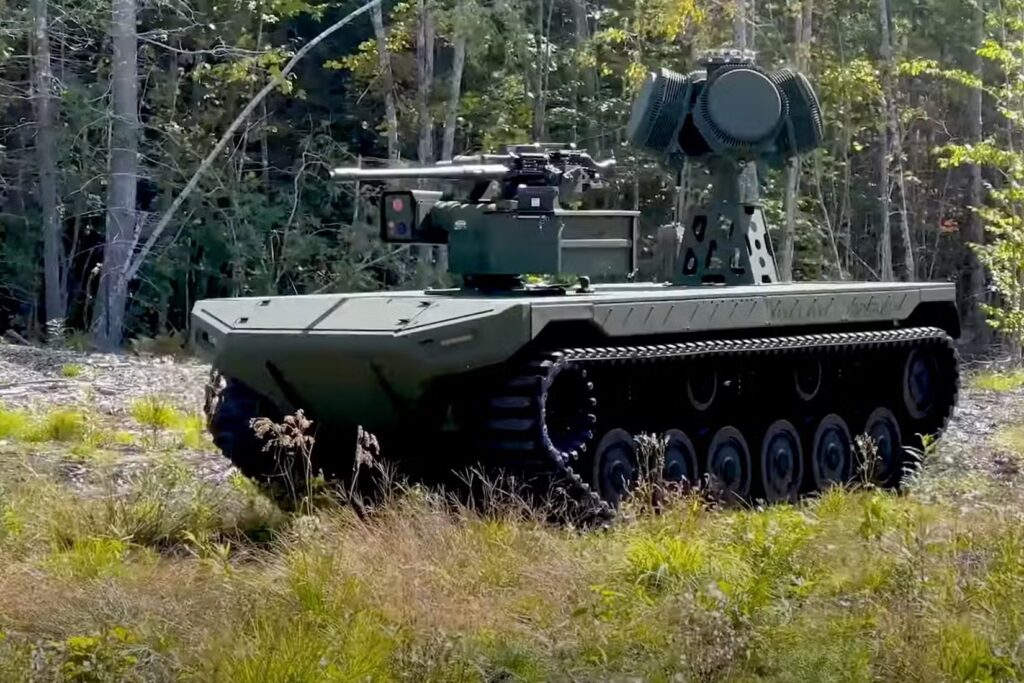
The United States Marine Corps has commissioned two RIPSAW M3 unmanned ground vehicles from Textron Systems and its subsidiary, Howe & Howe, to test new robotic capabilities for military operations. These platforms will be delivered to the Marine Corps Warfighting Laboratory (MCWL) in Quantico, Virginia, where they will serve as testbeds for the integration of sensors, equipment, and various payloads.
The current contract is not an acquisition intended to equip combat units; rather, it represents an initial experimental phase aimed at defining future ground robotics requirements for the Marines.
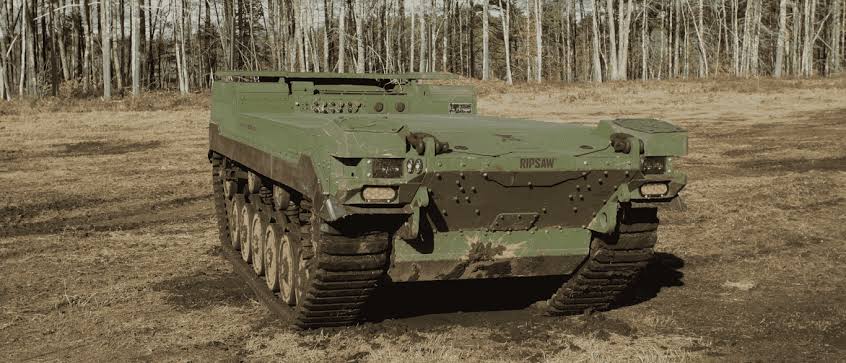
An electric, extended-range armored vehicle.
The RIPSAW M3 is an unmanned, tracked, armored vehicle featuring a hybrid-electric propulsion system and a modular architecture that allows for adaptation to a wide range of missions. The vehicle has a maximum gross weight of 8,165 kg and a payload capacity exceeding 2,268 kg. Its flat upper deck, spanning 5.85 square meters, is designed to accommodate reconnaissance equipment, sensors, communication systems, and other mission-specific modules. Additionally, it provides up to 10 kW of electrical power to support onboard systems.
A key feature of its design is the hybrid propulsion system, which allows the vehicle to operate using exclusively electric power, while an integrated range extender further increases its operational reach. This configuration combines the mobility of a tracked platform with the benefits of electric propulsion—an advantage particularly useful for minimizing noise during certain types of operations. Textron states that the vehicle is capable of over 19 hours of silent surveillance; however, this figure applies specifically to “Silent Watch” mode. Therefore, it should not be assumed that the vehicle can remain in motion for that duration while operating in a zero-emissions state.
The M3 model reaches a maximum speed of over 48 km/h and features a ground clearance of 35.6 centimeters, allowing it to overcome vertical obstacles up to 61 centimeters high and cross trenches or holes in the terrain measuring more than 1.22 meters. Its tractive capacity reaches 160% under peak conditions and 70% during continuous operation, while it is capable of navigating longitudinal slopes of up to 60% and lateral slopes of 50%. Furthermore, its width is approximately 2.03 meters, making it relatively compact and suitable for internal transport aboard CH-47 Chinook heavy-lift helicopters.
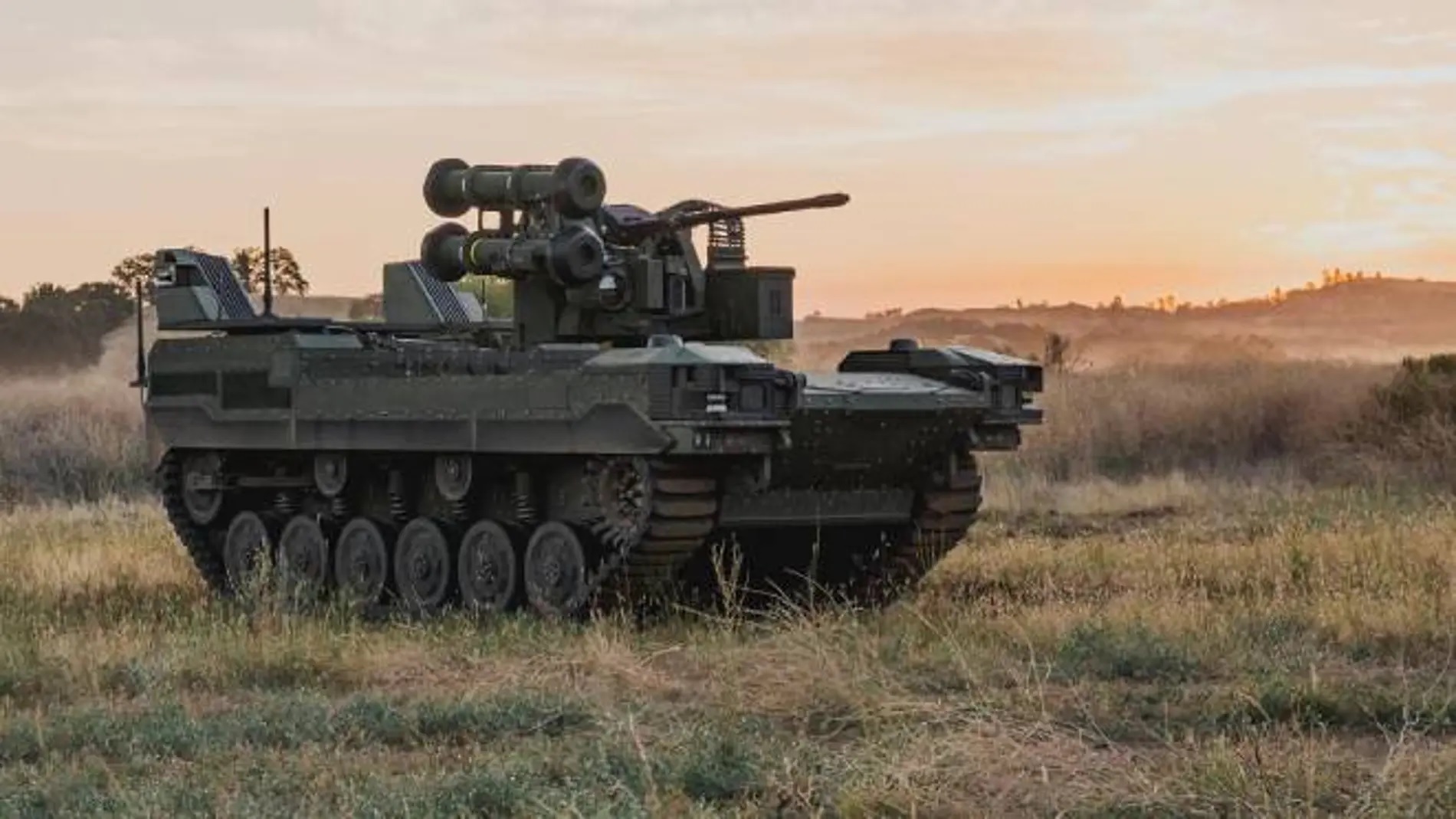
A modular tank.
Modular Open Systems Architecture (MOSA) is another of its fundamental features. This open-architecture system allows for the integration of various payloads, controllers, and autonomy packages without requiring significant modifications to the platform. Consequently, the Marines will be able to test different configurations on the same vehicle and evaluate which sensors and equipment are best suited for each specific mission.
Furthermore, it is essential that the vehicle be unmanned, enabling its deployment in areas where exposing personnel would pose a significant risk. However, this does not mean it can carry out every mission entirely autonomously, nor does it imply that it requires no human oversight. Its operation will be determined by the integrated control, navigation, and autonomy systems, as well as the specific conditions of each mission.
Michael Howe, senior vice president of the company, stated: “For over two decades, Howe and Howe, Inc. has developed high-capability, multi-domain, all-terrain platforms, with extreme-condition performance and durability as core design principles. The M3 will be a perfect fit for the Marine Corps and its demanding operational requirements across diverse environments.”
Potential applications include the transport of supplies, surveillance, reconnaissance, and support for ground units. As of this writing, it has not been specified which specific sensors or payloads the Marine Corps will install on the two units. It has also not been confirmed whether the testing will include the integration of weaponry. Finally, neither the cost nor the delivery timeline for the vehicles has been announced.