

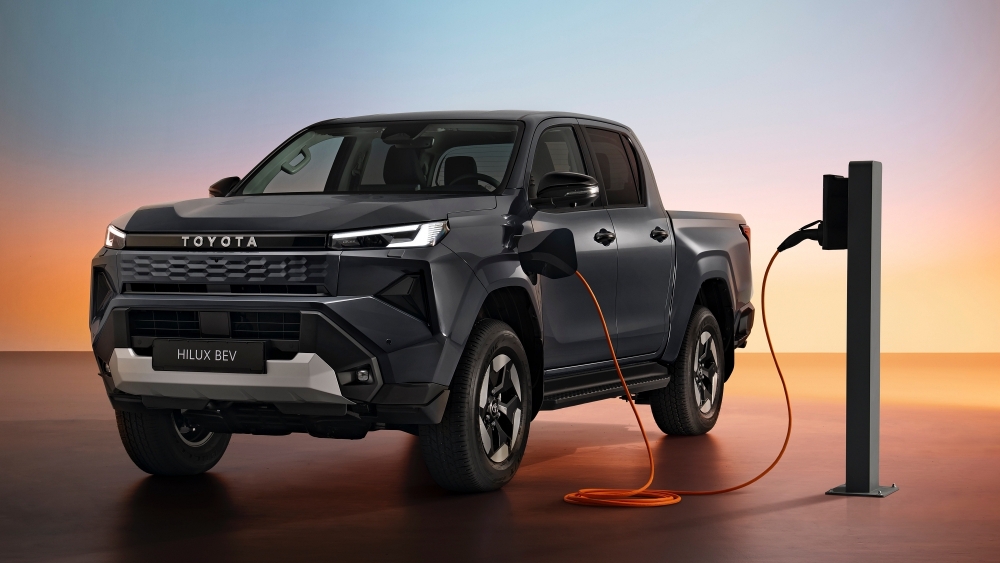
Sooner or later, this moment had to arrive. The Hilux is one of Toyota’s most important vehicles. A versatile pickup truck that now, for the first time, goes 100% electric.
It’s estimated that one in four cars on the road worldwide is a pickup truck. Pickups are versatile and highly functional vehicles for a wide range of tasks and jobs. They are indispensable tools in many regions of the world; South America, Australia, Africa, and North America, for example. In Europe, they have a more recreational focus, but their characteristics are the same or very similar. Now, just as everyone predicted, Toyota is launching the first 100% electric generation of the Hilux. The first in its 57-year history, although there are some unusual local precedents.
The Hilux is, in its own right, one of Toyota’s most important vehicles globally for the reasons already mentioned. Its first generation was launched in 1968, and it has been evolving ever since. Nine generations have come and gone, and now ten with the latest unveiling from the Japanese automaker. A new Hilux arrives on the market packed with new features, including a new design, more technology, and a versatile platform capable of adapting to almost any type of powertrain: from diesel to hydrogen to electric.
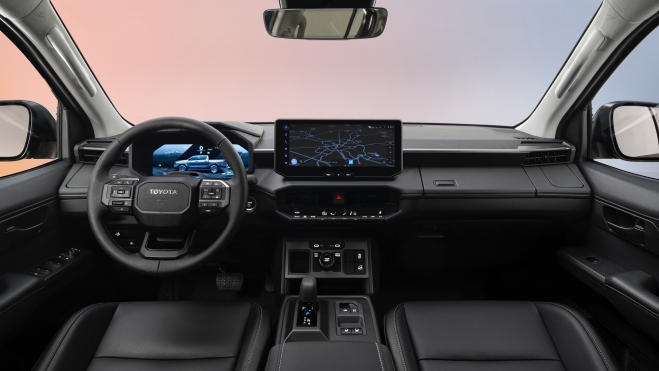
The Hilux significantly improved its presentation and technology.
Toyota focuses on cargo capacity, not range.
Toyota has left no stone unturned with the ninth-generation Hilux. The Hilux’s new exterior design was developed under the concept of “Robustness and Agility.” It boasts a powerful, distinctly American look, with a high front end and sharply defined lines. For now, only the double-cab version has been unveiled, although it’s almost certain the range will include more industrial versions with greater load capacity. Information on these is still somewhat limited. In its top-of-the-line version, it can tow up to 3,500 kilograms.
Toyota will offer a wide variety of powertrain options, including a new combustion engine version with a 48-volt auxiliary electrical system, which will receive the DGT’s ECO label in Spain. Even more significant is the ZERO emissions version. The Toyota Hilux BEV features a 59.2 kWh lithium-ion battery that powers front and rear electric motors to create the now-familiar all-wheel-drive system with Multi-Terrain Select. The electric model will have a load capacity of approximately 715 kilograms and a towing capacity of 1,600 kilograms.
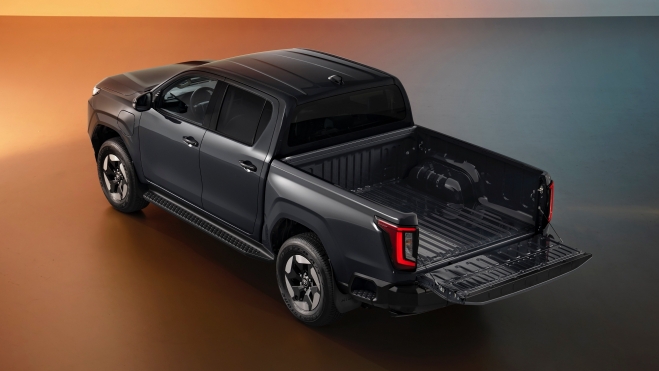
Nearly three-quarters of a ton for the first global electric Hilux.
The biggest drawback is that its official range falls far short of current standards. Toyota estimates the Hilux BEV will be able to travel 240 kilometers without needing to recharge. A distance that, by any measure, seems insufficient. A fuel cell-powered version, which the Japanese company has been developing for years, will arrive on the market in 2028. Toyota continues to champion hydrogen as an alternative mobility solution, even though the industry seems to have turned its back on it. The ninth generation will arrive on the market next year.