
The class develops why electronic fuels and synthetic fuels are not an alternative to decarbonize the vehicle fleet, and achieve net zero emissions.
Slide 2. Index.
- Electronic fuels.
- Disadvantages of electronic fuels.
Slide 3. Electronic fuels.
- The approval of electronic fuels in the European Union.
It is not known how or with what exceptions, but after the European Union has already approved the ban on the sale of diesel, gasoline and hybrid cars, that is combustion vehicles, from 2035 onwards, the so-called new synthetic fuels or electronic fuels or e-fuels, produced using electricity generated from renewable sources, now seem to be the only solution to definitively avoid the death of these vehicles in Europe.
Germany has asked the European Union to authorize them, and there is every indication that this will be the case, provided that the manufacturers can demonstrate that their vehicles will only be able to run on this type of electronic fuel from the next decade onwards.
Heavy transport has just received the approval of the European Parliament to use this type of electronic fuels to support its decarbonization process, and opens the door for the use of electronic fuels to also be allowed in passenger cars and vans.
- Manufacture of electronic fuels or synthetic fuels.
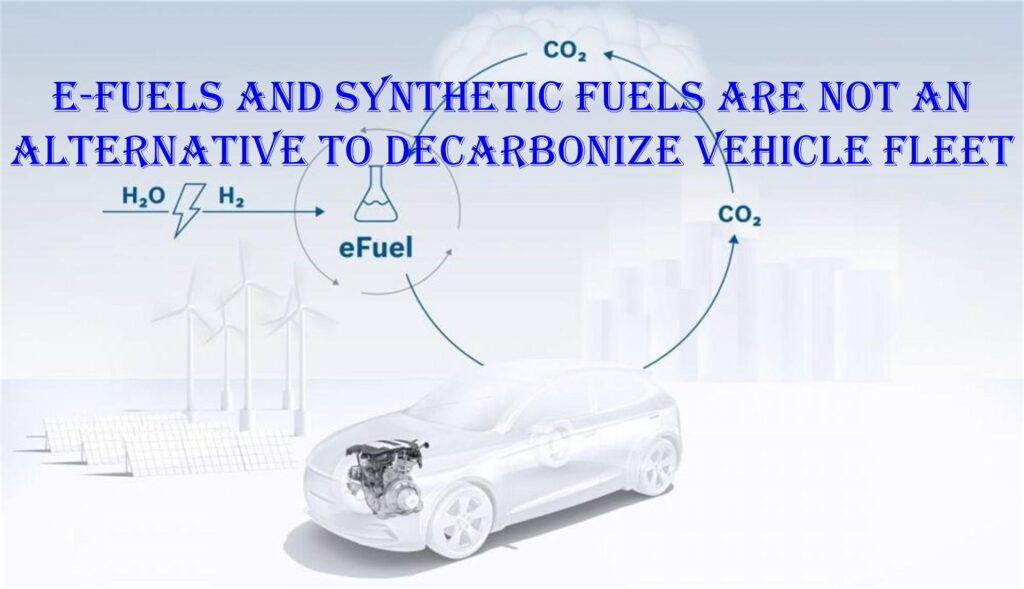
The most usual way of obtaining a CO2-neutral fuel is to synthesize it from the two main elements of a hydrocarbon: hydrogen and carbon. The former can be extracted from water and the latter from the air or captured from industrial processes. If, in addition, the whole process is carried out with electricity from renewable sources, they are called electronic fuels, electrofuels or e-fuels.
Hydrogen is present in H2O-water and can be separated from oxygen by electrolysis. When electricity is applied, the oxygen is released into the atmosphere and the hydrogen is stored. For this separation, a so-called proton exchange membrane-PEM is used, as in fuel cells, but in reverse. In a battery, hydrogen and oxygen are supplied separately to produce electricity, and the residual substance is water. Here, water and electricity go in, separate hydrogen and oxygen come out.
Methanol, a type of hydrocarbon, is created from the hydrogen and carbon. From this, other hydrocarbons can be synthesized. Gasoline and diesel are really cocktails of many different hydrocarbons. The process to arrive at equivalent electrofuels consists of creating some of these hydrocarbons and combining them to produce those with similar properties, usable directly in gasoline or diesel engines.
The Fischer Tropsch-FT process was patented by the Germans Franz Fischer and Hans Tropsch in 1925. The first industrial-scale pilot plant was built by Ruhrchemie AG in 1934 and industrialized on a large scale in 1936.
A similar process is electromethanation. This is an industrial technique that uses electricity to convert carbon dioxide CO2 into methane CH4, ethanol C2H6O, methanol CH3OH, butanol C4H10O, or other types of synthetic fuels.
All of them products that could be used in thermal engines. This process is considered a form of CO2 capture, as it allows converting CO2 emissions from industry into fuel.
In 2010, the first large-scale electromethanation pilot plant was inaugurated in Germany. Since then, several pilot plants of the same type have been built around the world. Electromethanization is more efficient than the Fischer Tropsch process, although its cost is now higher.
To achieve the goal of zero greenhouse gas emissions using e-fuels, it is necessary that the electrical energy used is produced by renewable energies.
- Types of electronic fuels.
-
- Synthetic gasoline.
It is produced by Fischer Tropsch synthesis or the methanol-to-gasoline process, converting hydrogen and CO2 into liquid hydrocarbons. The result is a fuel that could be used in any engine currently using gasoline.
-
- Synthetic diesel.
Using the same chemical process, what is known as renewable paraffinic diesel can be produced. This fuel has hydrogen and carbon dioxide as ingredients. The result of the reaction would be a fuel that is very similar to diesel at a chemical level, but much less polluting and with greater leeway for additives to reduce its toxicity.
-
- Synthetic alcohol.
Synthetic ethanol and methanol can be used as fuel, although they can also be used as gasoline additives to increase the octane rating.
-
- Synthetic kerosene.
In a world where air travel is increasingly criticized, this fuel could neutralize aviation emissions, which would mean a very drastic reduction in new greenhouse gas emissions.
-
- Hydrogen-based fuels.
Although we might not include it in this list, hydrogen can be considered the simplest synthetic fuel of all. It is also produced by electrolysis of water and is renewable. However, its viability is limited by the difficulty of transporting and storing it safely.
-
- Synthetic ammonia.
In this case, we have the opposite of hydrogen. Synthetic ammonia is easy to transport and store. Although it is not particularly useful as an energy source, it serves as a basis for producing other synthetic fuels. Hydrogen and nitrogen are used to produce it.
- Electronic fuels study.
A macro study commissioned by the German Climate Alliance, which includes more than 150 organizations, and carried out by the independent body of the Forum for Ecological-Social Market Economy, the FÖS, reveals that, although logically more necessary than traditional fuels, these new fuels will not prevent the death of thermal vehicles in passenger transport because they do not represent a viable alternative to electric cars in practice.
The study, in which experts from ADAC, the German Federal Environment Ministry and the International Energy Agency (IEA) participated, concluded that “synthetic fuel produced using electricity is too expensive, too difficult to obtain and too inefficient to keep combustion engine technology alive”. As a consequence, these organizations call for better promotion of electric cars and local public transport.
The study, in particular, gives many reasons to finally justify that e-fuels are not really the right solution for cars. One of them is that, even with significant government subsidies, they will not be available in the coming years in the quantities needed to meet the climate targets set for 2035. In addition, the experts assume that the European car fleet will be almost completely electrified by 2045 anyway.
The macro study has also logically examined the efficiency of these synthetic fuels, confirming that, for example, 150 onshore wind turbines could produce e-fuels for 37,500 combustion-engine vehicles. But if this electricity instead went directly to the batteries of electric cars, six times as many vehicles could be driven, according to the study.
The authors of the study stress, however, that it will continue to be necessary to produce e-fuel, especially for transport sectors that are currently more difficult to electrify, such as aviation and shipping.
The European Union has decided to set minimum e-fuel quotas for these sectors and, from 2026, airlines in Germany, for example, will have to operate their aircraft with a 0.5% blend of e-kerosene.
Slide 4. Disadvantages of electronic fuels.
- Very expensive prices.
Their production is expensive and requires large amounts of energy, which increases their price. In fact, the European Federation for Transport and Environment itself has already warned that the current forecast is that these fuels will reach a price of between 2 and 3 euros per liter, that is they will cost up to 50% more than traditional fuels, in the coming years.
Estimates suggest that synthetic gasoline, for example, will cost at least 2.80 euros per liter. Therefore, filling a 75-liter tank in Spain will cost around 210 euros in 7 years’ time.
Its use would cost for each car/van in the fleet, about 10,000 euros more for five years than if it were to travel in a 100% electric car whose energy source were the standard batteries that are already being used today.
- Shortage of electronic fuels.
Studies indicate that the volume of this type of electronic fuels expected to be available by 2035 will barely be enough to power 5 million cars out of a fleet forecast by the European Union at 287 million: “not even 2% of the cars in circulation will be able to use electronic fuels.
- They are inefficient and non-neutral.
A study published by Climate Strategy, ECODES, Environmentalists in Action, Renewable Foundation, SEO/Birdlife and Transport&Environment states that their use in road transport is “an aberration from the point of view of energy efficiency”.
This report states that, while using renewable electricity directly in the battery of a car results in a total energy efficiency of 77%, in the case of e-fuels the efficiency is 20% for electro-diesel and 16% for electro-gasoline.
These organizations also point out that to use this synthetic fuel in road transport it is necessary to “generate a large amount of additional renewable energy, which entails the installation of a significant number of extra renewable energy plants with their consequent impact on biodiversity”.
This report therefore now advocates the use of technical alternatives, such as direct electricity in battery vehicles, considering that electronic fuels “carry a huge energy penalty and risk derailing the whole decarbonization effort”.
- They emit more NOx and other particles.
These organizations also warn of the possibility of fraud that may occur if it cannot be guaranteed that drivers of internal combustion vehicles really refuel with this type of fuel, and not with conventional fossil fuels, and also ensure that these new synthetic fuels emit as much NOx as the current conventional ones, also causing an increase in carbon monoxide emissions.
And if that were not enough, the most alarming study that does not predict an easy path for the laboratory fuel assures that by 2030 an electric vehicle running exclusively on batteries will emit 53% less CO2 throughout its life cycle.
- Grams of CO2 per kilometer.
The oil industry is pushing for allowing e-fuels that are 70% cleaner than today’s gasoline and diesel. If this law is finally passed, vehicles running on e-fuels could emit 61 grams of CO2 equivalent by the distant year 2035.
If we compare them to an average European grid-powered electric vehicle in 2035, it would emit only 13 grams of CO2 per kilometer, although focusing on CO2 alone is not fair.
In addition to carbon dioxide, vehicles burning synthetic fuels are also capable of emitting air pollutant emissions in the form of NO2, a carcinogenic material. In turn, they emit the same amount of NOx, which are the dangerous particles that triggered the Dieselgate scandal, as fossil combustion engines. They also emit more carbon monoxide and ammonia.
- Synthetic fuels leave more of a pollution trail.
What seems clear is that as long as fuel is burned inside an engine, the air will remain toxic. The advantage of synthetic fuels is that you can have better control of the solid particles emitted into the atmosphere in return they are much more lethal in the emission of many other noxious gases, so the race to clean up the automobile by this route seems lost as of now.
-
- Considering the formulation of the new synthetic fuels, they are no more advantageous in NOx emissions than fossil fuels.
-
- A substantial reduction in solid particulate emissions has been observed. Those larger than 10 nanometer (nm) decreased by 97% in laboratory tests and between 81 and 86% in road tests. But even though this is a compelling advantage, engine manufacturers already offer technologies to limit this type of particulate matter below the legally mandated values using fossil fuels.
- A substantial reduction in solid particulate emissions has been observed. Those larger than 10 nanometer (nm) decreased by 97% in laboratory tests and between 81 and 86% in road tests. But even though this is a compelling advantage, engine manufacturers already offer technologies to limit this type of particulate matter below the legally mandated values using fossil fuels.
-
- Carbon monoxide CO emissions were up to 3 times higher in laboratory tests, and between 1.2 and 1.5 times higher in road tests.
-
- Although hydrocarbon emissions showed a theoretical advantage of 23 to 40% in tests, no real added advantage was validated in actual road tests.
-
- Ammonia emissions in different synthetic gasoline blends doubled during RDE-Real Driving Emissions on-road tests.
- Electricity demand.
In terms of energy demand, the inefficiency of synthetic fuel is balanced by another comparison: getting 10% of cars to be able to use them would increase electricity demand by 26%, which would also imply an additional mega-investment in the production of renewable energy plants, the gateway to being able to produce this type of fuel in road transport.
- Fleet management implications.
To achieve net zero emissions in a fleet of vehicles, 100% electric vehicles must be used, and their energy must be generated by renewable energies such as wind or solar power.
Because of all the disadvantages developed, electronic fuels are not an alternative to achieve net zero emissions in a fleet of vehicles, and it is recommended not to use them.
In addition, the use of e-fuels in the fleet may delay the use of 100% electric vehicles in the fleet.
Slide 5. Thank you for your time.
The class has developed why electronic fuels and synthetic fuels are not an alternative to decarbonize the vehicle fleet, and achieve net zero emissions, see you soon.
Bibliography.
https://www.autopista.es/noticias-motor/e-combustibles-sinteticos-no-evitaran-muerte-coche-diesel-gasolina_306114_102.html
https://www.autopista.es/noticias-motor/e-fuels-combustibles-sinteticos-la-gran-solucion-aberracion-energetica-sus-problemas_276458_102.html
https://www.autopista.es/noticias-motor/combustibles-sinteticos-e-fuel-contaminan-5-veces-mas-coche-electrico-segun-estudio_284202_102.html
https://www.autopista.es/noticias-motor/en-se-diferencian-e-fuels-combustibles-sinteticos-diesel-gasolina_274336_102.html
https://www.autopista.es/noticias-motor/combustibles-sinteticos-al-carajo-e-fuels-venian-salvar-coches-diesel-gasolina_265478_102.html
https://www.motorpasion.com/futuro-movimiento/que-que-se-diferencian-biofuels-e-fuels-combustibles-sinteticos-que-van-a-salvar-a-coches-gasolina-europa
https://www.mundodeportivo.com/urbantecno/motor/que-son-los-combustibles-sinteticos-y-que-tipos-hay
https://transporteprofesional.es/reportajes-transporte/combustibles-sinteticos-mas-alla-de-la-electromovilidad
The price of the training is 250 euros.
The training is asynchronous online, you can do it at your own pace, whenever and from wherever you want, you set the schedule.
Classes are video recorded.
Start date: The training can be started whenever you want. Once payment is made, you have access to the training.
The training is in English, subtitles and syllabus avalaible.
Other subtitles and video syllabus available: Arabic, Chinese, French, German, Indonesian, Italian, Japanese, Korean, Persian, Portuguese, Russian, Spanish, Thai, Turkish, Vietnamese.
All syllabus has been developed by the teacher.
Fill out the following form to receive course information, or write an email to:
Contact.
- José Miguel Fernández Gómez.
- Email: info@advancedfleetmanagementconsulting.com
- Mobile phone: +34 678254874 Spain.
Course Features.
- The course is aimed at: managers, middle managers, fleet managers, any professional related to electric vehicles, and any company, organization, public administration that wants to switch to electric vehicles.
- Schedule: at your own pace, you set the schedule.
- Duration: 28 hours.
- Completion time: Once you have started the course you have 6 months to finish it.
- Materials: english slides and syllabus for each class in PDF.
- If you pass the course you get a certificate.
- Each class has a quiz to take.
- English language, subtitles and syllabus.
- Other subtitles and video syllabus available: Arabic, Chinese, French, German, Indonesian, Italian, Japanese, Korean, Persian, Portuguese, Russian, Spanish, Thai, Turkish, Vietnamese.
-
Start date: The course can be started whenever you want. Once payment is made, you have access to the course.
Price.
- 250 euros.
-
You can pay by bank transfer, credit card, or PayPal.
Goals.
- Know the most important aspects to take into account when electrifying a fleet of vehicles.
- Learn about electric vehicle technology.
- Know the polluting emissions that occur when a fleet of vehicles is electrified.
- Know what technologies are viable to electrify a fleet of vehicles.
- Learn about real cases of vehicle fleet electrification.
- Know the history of the electric vehicle.
Syllabus.
Electric vehicle technology.
- History of the electric vehicle.
- Electric vehicle technology.
- Fundamentals of the electric vehicle battery.
- Other electric vehicle battery storage technologies.
- Electric vehicle battery components
- Battery Management System-BMS.
- Electric vehicle battery degradation.
- Impact of ambient temperature on battery performance.
- Fundamentals of the electric vehicle motor.
- Types of electric motors and their relationship with rare earths.
- An electric vehicle inverter: What it is and what it is used for.
- The use of rare earths in electric vehicles.
- Electric vehicle tires.
Electric vehicle battery.
- What is and is not covered by the electric vehicle battery warranty.
- The battery passport.
- A second life for electric vehicle batteries
Electric vehicle battery fire.
- Prevention, control, and extinguishing of electric vehicle battery fires.
- Fire safety regulations for electric vehicle batteries.
Charging Points: Problems and Solutions.
- Problems with electric car charging points and their possible solutions
- Copper theft from electric vehicle chargers
- Cybersecurity at charging points
Polluting emissions from electric vehicles.
- Which emits more CO2, an electric car or a car with an internal combustion engine?
- Polluting emissions from brakes
Key aspects of fleet electrification.
- Fleet electrification with plug-in hybrids: Problem or solution?
- Fleet electrification with hydrogen vehicles.
- Battery replacement: A feasible solution for urban fleets.
- The Hertz electrification case.
- The Huaneng case, the world’s first electrified and autonomous mining fleet.
- A real-life taxi case: Three true stories of electrification for economic reasons.
- The second life of the electric vehicle battery at Rome-Fiumicino Leonardo Da Vinci Airport.
- Consequences for the vehicle fleet if an electric vehicle brand goes bankrupt.
- The electric vehicle brands most likely to break down due to high temperatures.
- How to avoid premature obsolescence of electric vehicles in the fleet.
- Mileage manipulation to void the warranty.
- E-fuels and synthetic fuels are not an alternative for decarbonizing the vehicle fleet.
- The importance of electricity tariffs in reducing electric vehicle costs.
- Electric vehicles, artificial intelligence, and electricity demand.
Electric vehicle insurance.
- The price of electric vehicle insurance.
- Electric vehicle insurance and advanced driver assistance systems (ADAS).
Driving an electric vehicle.
- Electric vehicles cause more motion sickness than gasoline-powered vehicles.
- One-pedal driving: Risk of accidents.
Training teacher.
José Miguel Fernández Gómez is the manager of Advanced Fleet Management Consulting, a consulting company specialized in vehicle fleet management and the owner of the fleet management channel on YouTube AdvancedfleetmanagementTube.
Since 2007 I have been working in fleet management consultancy and training for all types of companies, organizations and public administrations. With this course I want to make my experience and knowledge acquired during my work and academic career in this discipline available to my clients.
I carry out consulting projects related to vehicle fleet management and collaborate with companies developing products/services in this market. I have worked at INSEAD (France), one of the best business schools in the world, as a Research Fellow at the Social Innovation Centre-Humanitarian Research Group.
I carried out consulting and research activities in a project for the United Nations refugee organization (UNHCR), optimizing the size and management of the activities of the vehicle fleet, which this organization has distributed throughout the world (6,500 vehicles).
I worked as a fleet manager for five years, for Urbaser, which managed the street cleaning service in Madrid (Spain). I managed a fleet of 1,000 vehicles, made up of various technologies and types of vehicles such as: heavy and light vehicles, vans, passenger cars or sweepers.
I have completed all my academic degrees at the Polytechnic University of Madrid, one of the best universities in Spain, my academic training is as follows:
I hold a PhD in Industrial Engineering, with international mention, since I carried out research stays at the University of Liverpool (UK) and at the Royal Institute of Technology-KTH (Sweden).
I am also an Industrial Engineer (Industrial Management) and an Mechanical Engineer, and I completed a Master’s Degree in Operations Management, Quality and Technological Innovation (Cepade) and another Master’s Degree in Industrial Management (UPM).
I have publications in indexed magazines and presentations at international industrial engineering conferences.
Cancellations and penalties.
Once the course has started, the amount will not be refunded.