
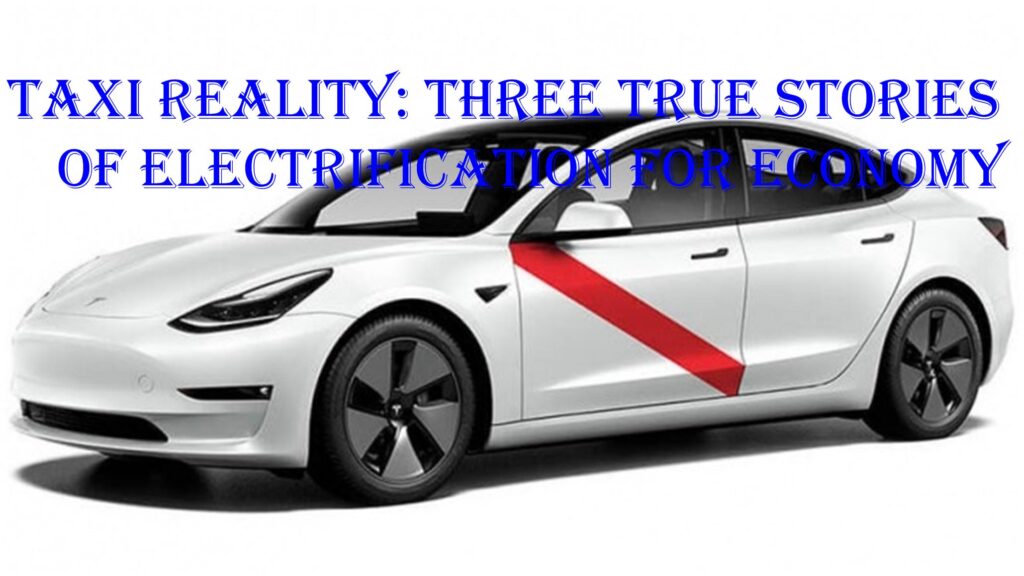
The class develops three cases of taxi drivers switching to electric vehicles for economic reasons, and the implications for fleet management.
Slide 2. Real-life taxi case study: Three real stories of switching to electric vehicles for economic reasons.
- History of electric taxis.
Electric vehicles are ideal for taxis and ride-hailing services due to the type of use they are put to and the advantages offered by zero-emission mobility in urban environments.
Today, it seems extremely avant-garde to see silent taxis in our cities that do not emit a single particle of polluting gas. It is worth noting that this situation already existed in some European capitals more than a century ago, and even in Spain eight decades ago.
There are records of electric taxis in Berlin in 1889, specifically a horse-drawn carriage powered by an electric motor that was used by customers of the Hotel Kaiser. In London, battery-powered vehicles were used as taxis from 1907 onwards. Later, in 1943, a fleet of electric taxis was introduced in Barcelona.
- Personal experience is the best example.
The average daily mileage of a taxi in Spain is between 300 and 400 kilometers, which is equivalent to the range that most current electric vehicles already achieve. All drivers have chargers at their respective homes, allowing them to start their working day with their batteries at 100% capacity.
It is important to note that the average fuel savings exceed 500 euros per month, depending on the number of working days.
More and more professional drivers are making the transition to electric cars for one reason: to save money. This is demonstrated by the cases in Spain of three taxi drivers in Vigo, Barcelona, and Valladolid who have switched from combustion engines to electric motors and have seen their monthly expenses reduced dramatically. In all cases, the economic impact was so evident that there was no turning back. “Gasoline cost me more than the car,” sums up one of them.
In Vigo, Julio Sousa made the decision in 2022, after conducting a financial analysis with his tax advisor. He replaced his old Peugeot diesel vehicle with a Tesla Model 3, financed through a payment plan, and connected the car to a special nighttime electricity rate.
The change in expense management has been remarkable, going from a monthly expenditure of approximately 600 euros on diesel to a current expenditure of just 60 euros on electricity. “The first month, I thought I had made a mistake, that some charge was missing. But no, I simply no longer needed to refuel.” In total, he estimates that he has saved approximately 7,000 euros in one year, which is equivalent to almost three full monthly payments on the vehicle. In addition, they benefit from additional advantages, such as free parking and unlimited access to areas restricted by low-emission regulations.
In the city of Barcelona, taxi driver Ángel García has distinguished himself as a leader in the adoption of electric mobility. For the past five years, he has been driving a 40 kWh Nissan Leaf, with which he has traveled approximately 200 kilometers a day in double shifts.
Although he initially had reservations about the vehicle’s range, he soon adapted his charging routines at midday and in the evening, and the results were impressive: while with a hybrid he would spend around 300 euros per month on fuel, his current electricity bill is around $65 per month. “I’ve saved more than 15,000 euros in five years, and the car is still running perfectly.”
In addition to the savings, Ángel highlights driving comfort as an unexpected improvement. “You arrive less tired, there are no vibrations, the car doesn’t make any noise, you’re not spending all day pressing the clutch or listening to the engine,” he explains. He also highlights his work as a promoter of electric technology among his colleagues in the sector. “There is a lot of ignorance, but when I show them the figures, their eyes are opened. There are already several of us at the taxi stand who are plugged in.”
The longest-running case is that of Roberto San José, a taxi driver in Valladolid and recognized as the pioneer in operating an electric vehicle in Spain. He started out in 2011 with a first-generation Nissan Leaf, at a time when the charging infrastructure did not yet exist. Despite this, Roberto has traveled more than 347,000 kilometers in his electric vehicle, meticulously documenting each refueling in an Excel spreadsheet that he uses in his presentations and interviews. The conclusion of the research is clear: “I have saved more than 32,000 euros compared to a diesel car,”.
Roberto breaks down the savings achieved: in fuel, he would have incurred an expense of approximately 35,394 euros in diesel during that period. In contrast, the cost of electricity was 5,830 euros. To this must be added maintenance, which includes no oil changes, belts, or clutches, and minimal battery degradation after more than ten years. “People are surprised, but the numbers don’t lie. The savings are huge. And best of all, it’s still working,” he says. He has also given lectures at vocational training institutes to share his experience.
Unfortunately, Roberto experienced an unfortunate incident with his Nissan Leaf, Spain’s first electric taxi, which resulted in a total loss. Following the unfortunate incident, the insurance company issued a formal statement classifying the vehicle as a “total loss.” After recovering from the incident, Roberto remained committed to electromobility and currently owns an electric Hyundai Ioniq. After traveling 266,127 kilometers, the Ioniq’s battery is in optimal condition, as detailed in a post on his LinkedIn profile.
The three taxi drivers share another characteristic: they all use electricity rates adapted to professional use, recharging mostly at night or during scheduled breaks. Julio, for example, signed up for a rate of 0.05 euros/kWh and always charges in his private parking space. Ángel offers a combination of slow public charging and charging at home. Roberto started out using conventional outlets until the city council installed specific charging points for taxis. “I’ve never been stranded,” he emphasizes.
Although each has their own brand and model, experience has united them in a common profile: that of the driver who is not chasing green flags, but profitability. Julio, without mincing words, says: “Then you realize that you are also polluting less, and that is an added value. But the first thing was to save money, without a doubt.”
- Implications for fleet management.
The main consequence of switching to electric vehicles is cost savings, especially in terms of energy.
These savings have been achieved mainly for three reasons.
- Because the electricity tariff is adapted to the professional use of the vehicle, it is recharged during lunch breaks and at night.
- The use of slow charging, which is the most economical of all charging methods.
- Having a charging point at home to recharge the vehicle at night.
The purchase cost of the electric vehicle is higher than its internal combustion counterpart, but based on the cost savings in the three cases described, everything indicates that the total cost of ownership (TCO) of the electric vehicle is lower than its internal combustion counterpart.
Some electricity companies offer cheaper or discounted electricity rates, tailored to the schedules of professional drivers such as taxi drivers, which are recommended.
In the case of taxi, ride-hailing, or mobility fleets, where the driver is an employee of the company, the company must pay for the installation of the charging point at the driver’s home and the electricity, and allow the driver to take the vehicle home.
Before hiring the driver, you must explain that they will need to recharge the vehicle at their home overnight, and make sure that this is possible, as they may not have a parking space where they can park the vehicle to recharge, or it may not be possible to install a charging point.
If they do not have a parking space to recharge the vehicle at home, they can rent one near where they live with a charger.
The driver is available to provide the service at any time of day, and does not have to travel to our facilities to pick up the vehicle, saving time.
It is recommended that the driver lives in the geographical area where the service is provided, to avoid empty trips from the driver’s place of residence to the area where the service is provided.
The driver must be trained on how to recharge the vehicle, always using the slowest recharge mode and at night, and not using public or third-party fast-recharge points.
It is also possible to have a private parking lot where all vehicles can be recharged at night, but this is a more expensive solution than if the driver takes the vehicle home due to the cost of the property, in addition to the difficulty of finding private parking lots for vehicles in city centers.
We will always have a private parking lot where we can keep some vehicles that are inactive for various reasons, but it is much smaller than if we had to recharge all the vehicles at night in the same private parking lot.
Another option instead of having our own private parking lot is to rent parking spaces in a public parking lot with charging points.
Slide 3. Thank you for your time.
The class has developed three cases of taxi driver electrification for economic reasons and the implications for fleet management.
Bibliography.
https://www.hibridosyelectricos.com/coches/he-ahorrado-mas-32000-euros-respecto-diesel-tres-historias-reales-cambio-coche-electrico-por-pura-economia_81407_102.html
https://www.iberdrola.es/blog/transporte/taxis-vtc-coches-electricos
The price of the training is 250 euros.
The training is asynchronous online, you can do it at your own pace, whenever and from wherever you want, you set the schedule.
Classes are video recorded.
Start date: The training can be started whenever you want. Once payment is made, you have access to the training.
The training is in English, subtitles and syllabus avalaible.
Other subtitles and video syllabus available: Arabic, Chinese, French, German, Indonesian, Italian, Japanese, Korean, Persian, Portuguese, Russian, Spanish, Thai, Turkish, Vietnamese.
All syllabus has been developed by the teacher.
Fill out the following form to receive course information, or write an email to:
Contact.
- José Miguel Fernández Gómez.
- Email: info@advancedfleetmanagementconsulting.com
- Mobile phone: +34 678254874 Spain.
Course Features.
- The course is aimed at: managers, middle managers, fleet managers, any professional related to electric vehicles, and any company, organization, public administration that wants to switch to electric vehicles.
- Schedule: at your own pace, you set the schedule.
- Duration: 27 hours.
- Completion time: Once you have started the course you have 6 months to finish it.
- Materials: english slides and syllabus for each class in PDF.
- If you pass the course you get a certificate.
- Each class has a quiz to take.
- English language, subtitles and syllabus.
- Other subtitles and video syllabus available: Arabic, Chinese, French, German, Indonesian, Italian, Japanese, Korean, Persian, Portuguese, Russian, Spanish, Thai, Turkish, Vietnamese.
-
Start date: The course can be started whenever you want. Once payment is made, you have access to the course.
Price.
- 250 euros.
-
You can pay by bank transfer, credit card, or PayPal.
Goals.
- Know the most important aspects to take into account when electrifying a fleet of vehicles.
- Learn about electric vehicle technology.
- Know the polluting emissions that occur when a fleet of vehicles is electrified.
- Know what technologies are viable to electrify a fleet of vehicles.
- Learn about real cases of vehicle fleet electrification.
- Know the history of the electric vehicle.
Syllabus.
- History of electric vehicle.
- Battery electric vehicle.
- History of the lithium ion battery.
- Types of electric vehicle batteries.
- New electric vehicle battery materials.
- Other storage technologies of electric vehicle batteries.
- Battery components.
- Battery Management System-BMS.
- The use of rare earths in the electric vehicle.
- Fundamentals of the electric motor.
- Types of electric motors and their relationship to rare earths.
- Electric vehicle inverter: what it is and what it is used for.
- Battery degradation loss of autonomy.
- What is covered and not covered by the electric vehicle battery warranty.
- Battery passport.
- Battery fire of the electric vehicle.
- Causes, stages and risks of battery fire.
- Real cases of electric vehicle fire.
- Electric vehicle battery fire extinguishment.
- Measures to prevent, extinguish and control electric vehicle fires.
- Fire safety regulations for electric vehicle batteries.
- Impact of ambient temperature on battery performance.
- The electric vehicle brands most likely to breakdown due to high temperatures.
- Which emmits more Co2, an electric car or a car with an internal combustion engine.
- Plug-in electric hybrids, a solution or an obstacle to electrify the vehicle fleet?.
- Fleet electrification with hydrogen vehicles.
- Cybersecurity of charging points.
- The theft of copper in electric vehicle chargers.
- Incidents at electric car charging points and their possible solutions.
- Batery swapping.
- The second life of the battery of the EV at Rome airport.
- The tires of electric vehicles.
- Electric vehicle, artificial intelligence, and electricity demand.
- The case of Hertz electrification.
- The case of Huaneng: The world’s first electrified and autonomous mining fleet
- Consequences on the vehicle fleet of an electric vehicle brand going bankruptcy.
- E-fuels and synthetic fuels are not an alternative to decarbonize the vehicle fleet.
- How to avoid premature obsolescence of the fleet’s electric vehicles.
- Polluting emissions from brakes.
- Mileage manipulation to extinguish warranty early on electric vehicles.
- The importance of the electricity tariff in reducing electric vehicle costs.
- Taxi reality: Three true stories of electrification for economy.
- Electric vehicles cause more motion sickness than gasoline vehicles.
- Electric vehicle insurance and advanced driver assistance systems-ADAS.
- One-pedal driving: Risk of accidents.
Training teacher.
José Miguel Fernández Gómez is the manager of Advanced Fleet Management Consulting, a consulting company specialized in vehicle fleet management and the owner of the fleet management channel on YouTube AdvancedfleetmanagementTube.
Since 2007 I have been working in fleet management consultancy and training for all types of companies, organizations and public administrations. With this course I want to make my experience and knowledge acquired during my work and academic career in this discipline available to my clients.
I carry out consulting projects related to vehicle fleet management and collaborate with companies developing products/services in this market. I have worked at INSEAD (France), one of the best business schools in the world, as a Research Fellow at the Social Innovation Centre-Humanitarian Research Group.
I carried out consulting and research activities in a project for the United Nations refugee organization (UNHCR), optimizing the size and management of the activities of the vehicle fleet, which this organization has distributed throughout the world (6,500 vehicles).
I worked as a fleet manager for five years, for Urbaser, which managed the street cleaning service in Madrid (Spain). I managed a fleet of 1,000 vehicles, made up of various technologies and types of vehicles such as: heavy and light vehicles, vans, passenger cars or sweepers.
I have completed all my academic degrees at the Polytechnic University of Madrid, one of the best universities in Spain, my academic training is as follows:
I hold a PhD in Industrial Engineering, with international mention, since I carried out research stays at the University of Liverpool (UK) and at the Royal Institute of Technology-KTH (Sweden).
I am also an Industrial Engineer (Industrial Management) and an Mechanical Engineer, and I completed a Master’s Degree in Operations Management, Quality and Technological Innovation (Cepade) and another Master’s Degree in Industrial Management (UPM).
I have publications in indexed magazines and presentations at international industrial engineering conferences.
Cancellations and penalties.
Once the course has started, the amount will not be refunded.