
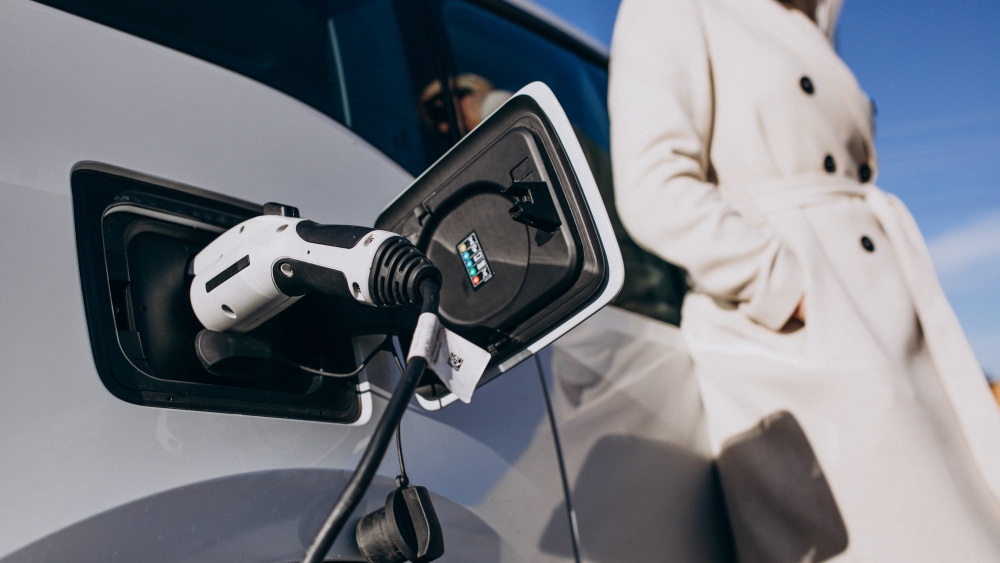
Three real stories reveal how electric cars transformed their lives, with savings of up to €32,000 in costs compared to a diesel car.
Far from futuristic headlines or ideological debates, more and more professional drivers are making the transition to electric cars for one reason alone: to save money. This is demonstrated by the cases of three taxi drivers in Vigo, Barcelona, and Valladolid who have switched from combustion engines to electric motors and have seen their monthly expenses reduced dramatically. In all cases, the economic impact was so evident that there was no turning back. “Gasoline cost me more than the car,” sums up one of them.
The best example is personal experience
In Vigo, Julio Sousa made the decision in 2022, after doing the math with his tax advisor. He traded in his old diesel Peugeot for a Tesla Model 3, financed in installments, and connected the car to a special nighttime electricity rate. He went from spending about $600 a month on diesel to just $60 on electricity. “The first month, I thought I had made a mistake, that there was a charge missing. But no, I just didn’t need to refuel anymore,” he says. In total, he estimates that he has saved around €7,000 in a single year, which is equivalent to almost three full monthly payments on the car, he explains in an interview with La Voz de Galicia. He also enjoys additional benefits such as free parking and unrestricted access to Low Emission Zones.
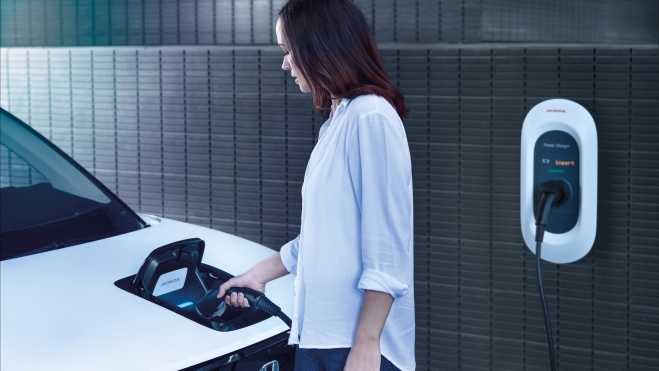
“Gasoline cost me more than the car,” explains one of the cases.
In Barcelona, taxi driver Ángel García has been committed to electric mobility for some time. For the past five years, he has been driving a 40 kWh Nissan Leaf, with which he travels about 200 kilometers a day in double shifts. Although he was initially concerned about range, he soon adapted his breaks to charge at midday and at night, and the numbers spoke for themselves: while with a hybrid he would spend around $300 per month on fuel, his current electricity bill is around $65 per month. “I’ve saved more than €15,000 in five years, and the car is still running perfectly,” he said in an interview with La Vanguardia.
In addition to the savings, Angel highlights driving comfort as an unexpected improvement. “You arrive less tired, there are no vibrations, the car makes no noise, you’re not spending all day pressing the clutch or listening to the engine,” he explains. He also acknowledges that he has become an “electric evangelist” among his colleagues. “There is a lot of ignorance, but when I show them the numbers, their eyes open. There are already several of us at the taxi rank who are plugged in.”
The most veteran case is that of Roberto San José, a taxi driver in Valladolid and considered the first to operate an electric car in Spain. He started in 2011 with a first-generation Nissan Leaf, when there was hardly any charging infrastructure. Even so, Roberto has driven more than 347,000 kilometers in his electric car and has documented every refueling in an Excel spreadsheet that he uses in his talks and interviews. His conclusion is clear: “I’ve saved more than €32,000 compared to a diesel car,” he tells Iberisa.
Roberto breaks down those savings: in fuel, he would have spent about €35,394 on diesel during that time. Instead, he has spent only €5,830 on electricity. On top of that, there is maintenance: no oil changes, no belts or clutches, and minimal battery degradation after more than a decade. “People are surprised, but the numbers don’t lie. The savings are huge. And best of all, it’s still working,” he says. He has even given talks at vocational training institutes to explain his experience.
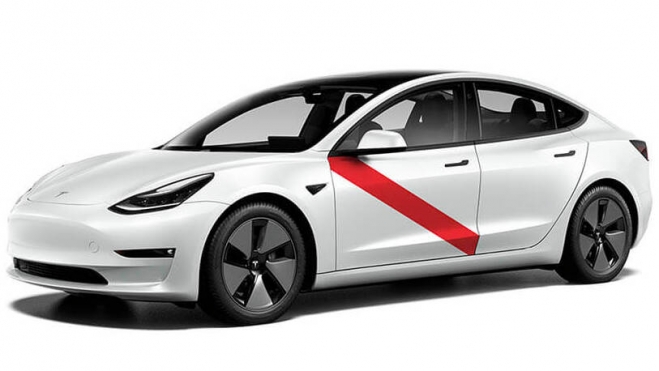
The Tesla Model 3 is one of the cars used in one of the real stories.
Unfortunately, Roberto had an accident with his Nissan Leaf, Spain’s first electric taxi, leaving it a total write-off. After the accident, the insurance company declared the car a “total loss.” After recovering from the incident, Roberto continued to support electromobility and currently drives an electric Hyundai Ioniq: “Amazing. After 266,127 kilometers, the Ioniq’s battery is at 100%,” he says in a post on his personal LinkedIn account.
Electricity rates adapted to professional use
The three taxi drivers share another pattern: they all use electricity rates adapted to professional use, recharging mostly at night or during scheduled breaks. Julio, for example, signed up for a rate of €0.05/kWh and always charges at his private parking spot. Ángel combines free slow public charging with charging at home. And Roberto started with conventional outlets until his city council installed specific charging points for taxis. “I’ve never been stranded,” he emphasizes.
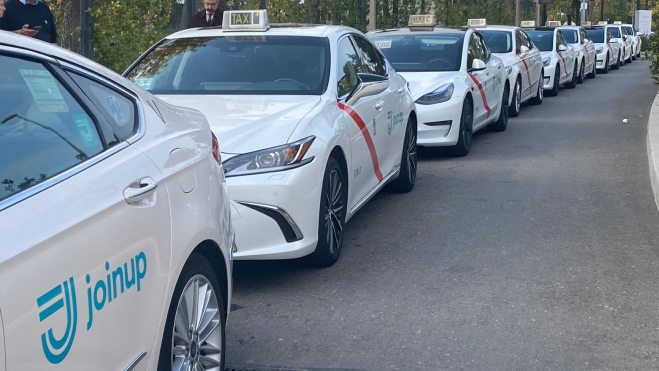
It is increasingly common to see 100% electric taxis on the roads.
Although each one has its own make and model, experience has united them in a common profile: that of the driver who is not looking for green flags, but profitability. “It wasn’t for the environment, it was for the economy,” Julio says bluntly. “Then you realize that you are also polluting less, and that is an added value. But the first thing was to save money, without a doubt.”
Industry experts such as Joan Groizard, director of the Institute for Energy Diversification and Saving (IDAE), agree with this practical view. In recent statements, he asserted that the electric car is now “the most rational option” from an economic point of view, if you add up the energy savings, public subsidies, and lower maintenance costs. “And especially in the case of professional drivers, where mileage more than justifies the initial investment,” he emphasized.
In a context of rising fuel prices and increasingly strict regulations, these testimonials provide a different narrative than usual. “My car pays for itself,” Ángel sums up. And as in the best businesses, the numbers rule.
The price of the training is 250 euros.
The training is asynchronous online, you can do it at your own pace, whenever and from wherever you want, you set the schedule.
Classes are video recorded.
Start date: The training can be started whenever you want. Once payment is made, you have access to the training.
The training is in English, subtitles and syllabus avalaible.
Other subtitles and video syllabus available: Arabic, Chinese, French, German, Indonesian, Italian, Japanese, Korean, Persian, Portuguese, Russian, Spanish, Thai, Turkish, Vietnamese.
All syllabus has been developed by the teacher.
Fill out the following form to receive course information, or write an email to:
Contact.
- José Miguel Fernández Gómez.
- Email: info@advancedfleetmanagementconsulting.com
- Mobile phone: +34 678254874 Spain.
Course Features.
- The course is aimed at: managers, middle managers, fleet managers, any professional related to electric vehicles, and any company, organization, public administration that wants to switch to electric vehicles.
- Schedule: at your own pace, you set the schedule.
- Duration: 25 hours.
- Completion time: Once you have started the course you have 6 months to finish it.
- Materials: english slides and syllabus for each class in PDF.
- If you pass the course you get a certificate.
- Each class has a quiz to take.
- English language, subtitles and syllabus.
- Other subtitles and video syllabus available: Arabic, Chinese, French, German, Indonesian, Italian, Japanese, Korean, Persian, Portuguese, Russian, Spanish, Thai, Turkish, Vietnamese.
-
Start date: The course can be started whenever you want. Once payment is made, you have access to the course.
Price.
- 250 euros.
-
You can pay by bank transfer, credit card, or PayPal.
Goals.
- Know the most important aspects to take into account when electrifying a fleet of vehicles.
- Learn about electric vehicle technology.
- Know the polluting emissions that occur when a fleet of vehicles is electrified.
- Know what technologies are viable to electrify a fleet of vehicles.
- Learn about real cases of vehicle fleet electrification.
- Know the history of the electric vehicle.
Syllabus.
- History of electric vehicle.
- Battery electric vehicle.
- History of the lithium ion battery.
- Types of electric vehicle batteries.
- New electric vehicle battery materials.
- Other storage technologies of electric vehicle batteries.
- Battery components.
- Battery Management System-BMS.
- Fundamentals of the electric motor.
- Battery degradation loss of autonomy.
- What is covered and not covered by the electric vehicle battery warranty.
- Battery passport.
- Battery fire of the electric vehicle.
- Causes, stages and risks of battery fire.
- Real cases of electric vehicle fire.
- Electric vehicle battery fire extinguishment.
- Measures to prevent, extinguish and control electric vehicle fires.
- Fire safety regulations for electric vehicle batteries.
- Impact of ambient temperature on battery performance.
- Which emmits more Co2, an electric car or a car with an internal combustion engine.
- The use of rare earth earths in the electric vehicle.
- Plug-in electric hybrids, a solution or an obstacle to electrify the vehicle fleet?.
- Fleet electrification with hydrogen vehicles.
- Cybersecurity of charging points.
- The theft of copper in electric vehicle chargers.
- Incidents at electric car charging points and their possible solutions.
- Batery swapping.
- The second life of the battery of the electric vehicle at Rome-Fiumicino Leonardo Da Vinci airport.
- The tires of electric vehicles.
- Electric vehicle, artificial intelligence, and electricity demand.
- The case of Hertz electrification.
- The case of Huaneng: The world’s first electrified and autonomous mining fleet.
- Consequences on the vehicle fleet of an electric vehicle brand going bankruptcy.
- E-fuels and synthetic fuels are not an alternative to decarbonize the vehicle fleet.
- How to avoid premature obsolescence of the fleet’s electric vehicles.
- Polluting emissions from brakes.
- Mileage manipulation to extinguish warranty early on electric vehicles.
- The importance of the electricity tariff in reducing electric vehicle costs.
- Electric vehicles cause more motion sickness than gasoline vehicles.
- Electric vehicle insurance and advanced driver assistance systems-ADAS.
- One-pedal driving Risk of accidents.
Training teacher.
José Miguel Fernández Gómez is the manager of Advanced Fleet Management Consulting, a consulting company specialized in vehicle fleet management and the owner of the fleet management channel on YouTube AdvancedfleetmanagementTube.
Since 2007 I have been working in fleet management consultancy and training for all types of companies, organizations and public administrations. With this course I want to make my experience and knowledge acquired during my work and academic career in this discipline available to my clients.
I carry out consulting projects related to vehicle fleet management and collaborate with companies developing products/services in this market. I have worked at INSEAD (France), one of the best business schools in the world, as a Research Fellow at the Social Innovation Centre-Humanitarian Research Group.
I carried out consulting and research activities in a project for the United Nations refugee organization (UNHCR), optimizing the size and management of the activities of the vehicle fleet, which this organization has distributed throughout the world (6,500 vehicles).
I worked as a fleet manager for five years, for Urbaser, which managed the street cleaning service in Madrid (Spain). I managed a fleet of 1,000 vehicles, made up of various technologies and types of vehicles such as: heavy and light vehicles, vans, passenger cars or sweepers.
I have completed all my academic degrees at the Polytechnic University of Madrid, one of the best universities in Spain, my academic training is as follows:
I hold a PhD in Industrial Engineering, with international mention, since I carried out research stays at the University of Liverpool (UK) and at the Royal Institute of Technology-KTH (Sweden).
I am also an Industrial Engineer (Industrial Management) and an Mechanical Engineer, and I completed a Master’s Degree in Operations Management, Quality and Technological Innovation (Cepade) and another Master’s Degree in Industrial Management (UPM).
I have publications in indexed magazines and presentations at international industrial engineering conferences.
Cancellations and penalties.
Once the course has started, the amount will not be refunded.