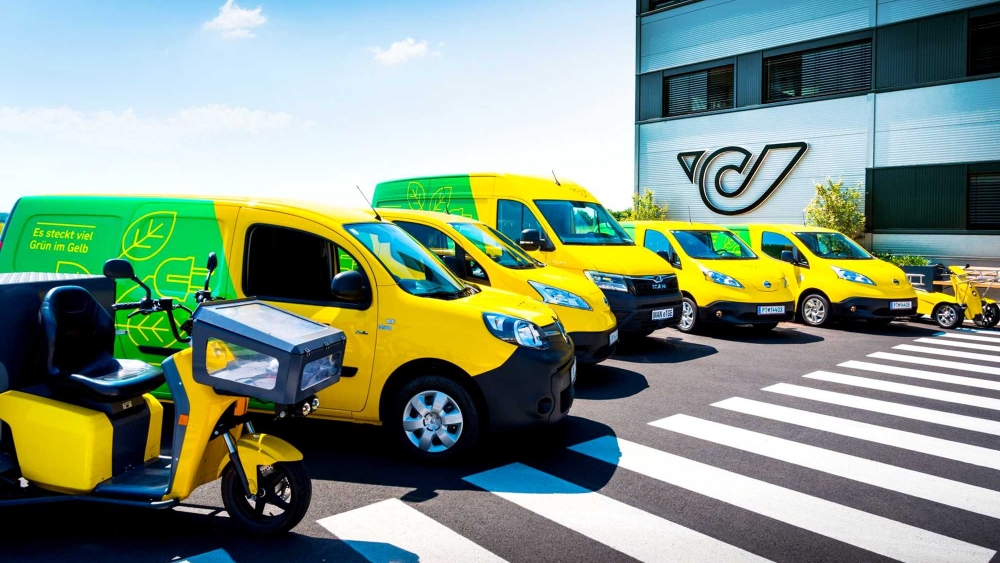
Thanks to the work begun in 2022 by Swiss Post, Vienna will have only electric vehicles in its fleet this year.
Commercial vehicle fleets, together with rental companies, account for the largest volume of new cars sold in Europe, around 60%. That is why their weight in the sales mix is so important, and when an entity, whether private or public, chooses to switch to zero emissions, the European Union is a little closer to its goal. The latest to join the clean mobility movement is Vienna, which has confirmed that by the end of this year, its entire postal service will be emission-free.
The postal service began its transformation some time ago, a process in which Swiss Post is investing around €32 million in charging infrastructure and electric vehicles. The highlight is the capital, Vienna, where it has 17 distribution bases spread throughout the city. When the system is fully implemented at the end of the year, the more than 1,500 workers involved in delivery will do so completely without CO2 emissions, whether in electric vehicles, by bicycle, or on foot.
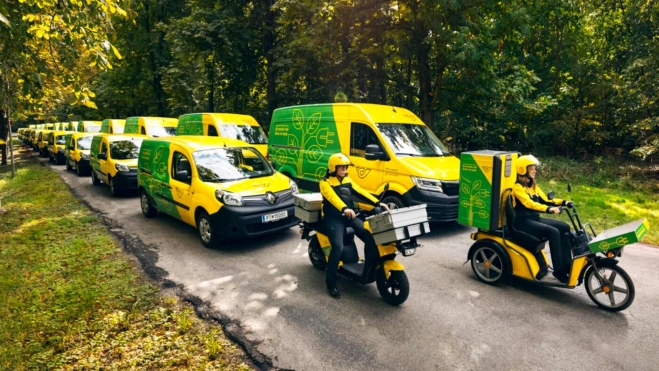
The fleet consists of a variety of vehicles.
On foot, by bicycle, or by electric vehicle
Getting to this point has not been a quick fix; Austrian Post has been working toward this goal for years. Since 2022, the company has only purchased electric vehicles for delivery throughout the country, gradually transforming its fleet into a zero-emission one. The pace of acquisition has been 1,000 new electric vehicles each year, with around 5,000 currently on Austrian roads. Furthermore, the ultimate goal is clear: by 2030, the entire delivery fleet, consisting of 10,000 vehicles, will be emission-free.
Peter Umundum, member of the Board of Directors for Parcel and Logistics at Austrian Post AG, explains: “With around 700 electric vehicles, more than half of our fleet in Vienna is already electric. By the end of the year, we will install the remaining charging stations and put another 400 electric vehicles into operation in Vienna. By the end of the year, more than two million residents will receive last-mile deliveries without CO2 emissions. This is unique in Europe!”
Walter Oblin, CEO of Swiss Post, said: “Even in difficult times, we are staying the course and continuing with our sustainability strategy. With the comprehensive transition to electric mobility in Vienna, our federal capital will become the first European metropolis of this size where all postal deliveries are made exclusively on foot, by bicycle, or by electric vehicle. This investment underscores our commitment and marks an important milestone on the road to an environmentally friendly future.”
The postal service even produces its own electricity
To power a fully electric fleet requires a considerable amount of energy, which is why Swiss Post has invested in the creation of plants to produce its own electricity. It has installed photovoltaic systems at 34 locations throughout Austria with a total capacity of more than 18 MWP, generating more than 20% of the energy needed for its vehicles and enabling up to 3,000 to be recharged.
The price of the training is 250 euros.
The training is asynchronous online, you can do it at your own pace, whenever and from wherever you want, you set the schedule.
Classes are video recorded.
Start date: The training can be started whenever you want. Once payment is made, you have access to the training.
The training is in English, subtitles and syllabus avalaible.
Other subtitles and video syllabus available: Arabic, Chinese, French, German, Indonesian, Italian, Japanese, Korean, Persian, Portuguese, Russian, Spanish, Thai, Turkish, Vietnamese.
All syllabus has been developed by the teacher.
Fill out the following form to receive course information, or write an email to:
Contact.
- José Miguel Fernández Gómez.
- Email: info@advancedfleetmanagementconsulting.com
- Mobile phone: +34 678254874 Spain.
Course Features.
- The course is aimed at: managers, middle managers, fleet managers, any professional related to electric vehicles, and any company, organization, public administration that wants to switch to electric vehicles.
- Schedule: at your own pace, you set the schedule.
- Duration: 25 hours.
- Completion time: Once you have started the course you have 6 months to finish it.
- Materials: english slides and syllabus for each class in PDF.
- If you pass the course you get a certificate.
- Each class has a quiz to take.
- English language, subtitles and syllabus.
- Other subtitles and video syllabus available: Arabic, Chinese, French, German, Indonesian, Italian, Japanese, Korean, Persian, Portuguese, Russian, Spanish, Thai, Turkish, Vietnamese.
-
Start date: The course can be started whenever you want. Once payment is made, you have access to the course.
Price.
- 250 euros.
-
You can pay by bank transfer, credit card, or PayPal.
Goals.
- Know the most important aspects to take into account when electrifying a fleet of vehicles.
- Learn about electric vehicle technology.
- Know the polluting emissions that occur when a fleet of vehicles is electrified.
- Know what technologies are viable to electrify a fleet of vehicles.
- Learn about real cases of vehicle fleet electrification.
- Know the history of the electric vehicle.
Syllabus.
- History of electric vehicle.
- Battery electric vehicle.
- History of the lithium ion battery.
- Types of electric vehicle batteries.
- New electric vehicle battery materials.
- Other storage technologies of electric vehicle batteries.
- Battery components.
- Battery Management System-BMS.
- Fundamentals of the electric motor.
- Battery degradation loss of autonomy.
- What is covered and not covered by the electric vehicle battery warranty.
- Battery passport.
- Battery fire of the electric vehicle.
- Causes, stages and risks of battery fire.
- Real cases of electric vehicle fire.
- Electric vehicle battery fire extinguishment.
- Measures to prevent, extinguish and control electric vehicle fires.
- Fire safety regulations for electric vehicle batteries.
- Impact of ambient temperature on battery performance.
- Which emmits more Co2, an electric car or a car with an internal combustion engine.
- The use of rare earth earths in the electric vehicle.
- Plug-in electric hybrids, a solution or an obstacle to electrify the vehicle fleet?.
- Fleet electrification with hydrogen vehicles.
- Cybersecurity of charging points.
- The theft of copper in electric vehicle chargers.
- Incidents at electric car charging points and their possible solutions.
- Batery swapping.
- The second life of the battery of the electric vehicle at Rome-Fiumicino Leonardo Da Vinci airport.
- The tires of electric vehicles.
- Electric vehicle, artificial intelligence, and electricity demand.
- The case of Hertz electrification.
- The case of Huaneng: The world’s first electrified and autonomous mining fleet.
- Consequences on the vehicle fleet of an electric vehicle brand going bankruptcy.
- E-fuels and synthetic fuels are not an alternative to decarbonize the vehicle fleet.
- How to avoid premature obsolescence of the fleet’s electric vehicles.
- Polluting emissions from brakes.
- Mileage manipulation to extinguish warranty early on electric vehicles.
- The importance of the electricity tariff in reducing electric vehicle costs.
- Electric vehicles cause more motion sickness than gasoline vehicles.
- Electric vehicle insurance and advanced driver assistance systems-ADAS.
- One-pedal driving Risk of accidents.
Training teacher.
José Miguel Fernández Gómez is the manager of Advanced Fleet Management Consulting, a consulting company specialized in vehicle fleet management and the owner of the fleet management channel on YouTube AdvancedfleetmanagementTube.
Since 2007 I have been working in fleet management consultancy and training for all types of companies, organizations and public administrations. With this course I want to make my experience and knowledge acquired during my work and academic career in this discipline available to my clients.
I carry out consulting projects related to vehicle fleet management and collaborate with companies developing products/services in this market. I have worked at INSEAD (France), one of the best business schools in the world, as a Research Fellow at the Social Innovation Centre-Humanitarian Research Group.
I carried out consulting and research activities in a project for the United Nations refugee organization (UNHCR), optimizing the size and management of the activities of the vehicle fleet, which this organization has distributed throughout the world (6,500 vehicles).
I worked as a fleet manager for five years, for Urbaser, which managed the street cleaning service in Madrid (Spain). I managed a fleet of 1,000 vehicles, made up of various technologies and types of vehicles such as: heavy and light vehicles, vans, passenger cars or sweepers.
I have completed all my academic degrees at the Polytechnic University of Madrid, one of the best universities in Spain, my academic training is as follows:
I hold a PhD in Industrial Engineering, with international mention, since I carried out research stays at the University of Liverpool (UK) and at the Royal Institute of Technology-KTH (Sweden).
I am also an Industrial Engineer (Industrial Management) and an Mechanical Engineer, and I completed a Master’s Degree in Operations Management, Quality and Technological Innovation (Cepade) and another Master’s Degree in Industrial Management (UPM).
I have publications in indexed magazines and presentations at international industrial engineering conferences.
Cancellations and penalties.
Once the course has started, the amount will not be refunded.