
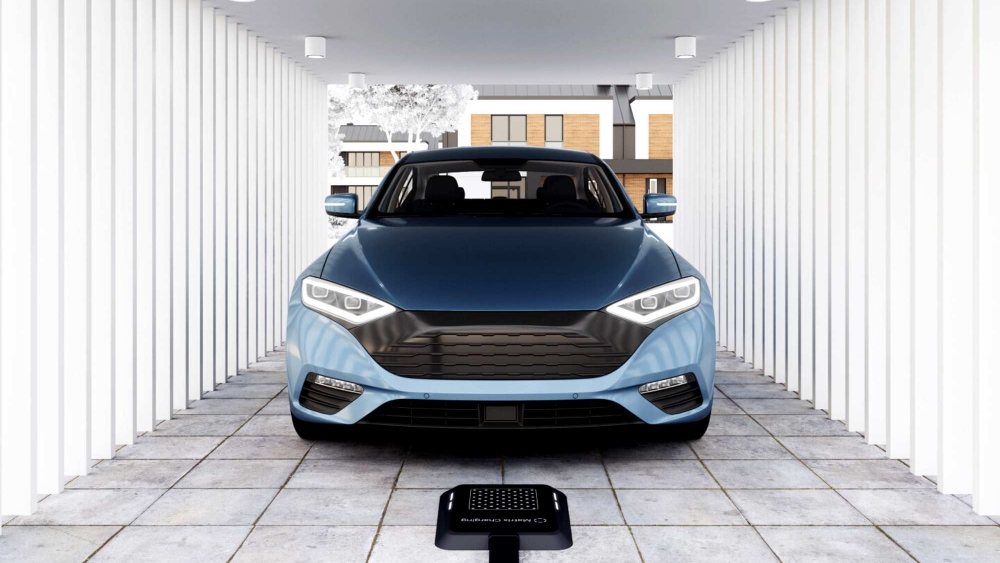
The Matrix Charging Interest Group (MCIG) presents a wireless charging system with a physical connection that is compatible with all manufacturers.
Electric cars continue to improve, and one of the areas where progress has recently been made is wireless charging. It’s a concept that has been under consideration for some time, but until now, it hasn’t been implemented on a large scale. Porsche has led the way by offering inductive charging in its new electric Cayenne, but some see a different alternative: driving-through charging. The Matrix Charging Interest Group (MCIG) advocates for its standardization in the market.
It focuses on the work of the Austrian company Easelink, which developed Matrix Charging, an automated charging system. The MCIG includes Easelink itself, as well as renowned car manufacturers such as Audi, Nissan, and Voyah. The reason for the project lies in the fact that, since it is a type of cargo that is taking its first steps, if it is standardized, it will be possible to advance more quickly in its development and make it universal.
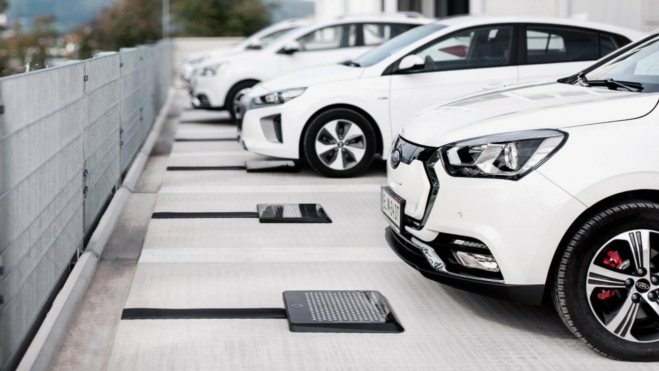
If it becomes widespread, costs would decrease.
Advantages of Conductive Charging
It’s important to understand the differences between inductive and conductive charging. Both eliminate the need for cables, but they operate differently. Conductive charging is easy to understand: the vehicle is positioned on a platform installed on the ground, as with inductive charging, but a plate integrated into the car’s underbody lowers to establish a physical charging connection, which is different. The operation is similar to inductive systems, but in this case, wireless transmission is eliminated in favor of direct contact, which prevents energy loss during transfer.
The creation of MCIG is based on the idea that offering a unified front will facilitate the development of this technology. If the system type is standardized, many different manufacturers will be able to use the same components, making its integration much faster and less expensive. They point out that several brands are evaluating the possibility of integrating this system into future production models and need a unified charging interface that guarantees interoperability between vehicles and automated infrastructure.
Hermann Stockinger, founder and CEO of MCIG, stated: “Our goal is to establish Matrix Charging as the global standard for automated charging. By making our core patents available under FRAND terms, we provide MCIG members with maximum operational flexibility and planning security, both for the use and future development of the technology.”
Alternatives to Wired Charging
Both inductive and ride-hailing charging aim to streamline the electric vehicle charging process by eliminating cables, making it as simple for drivers as parking their vehicle in a designated space and letting the charging process begin automatically. The drawback is that they cannot operate at the same power levels as fast-charging systems, but given that they are in the early stages of development, this could be achieved over time.
Menno Treffers, president of the group, comments: “MCIG follows the successful Special Interest Group model, like those that drove the development of Bluetooth and NFC. Its mission is to standardize the Matrix Charging interface, oversee its cross-sector market introduction, and ensure validation, testing, and certification according to clearly defined industry specifications.”