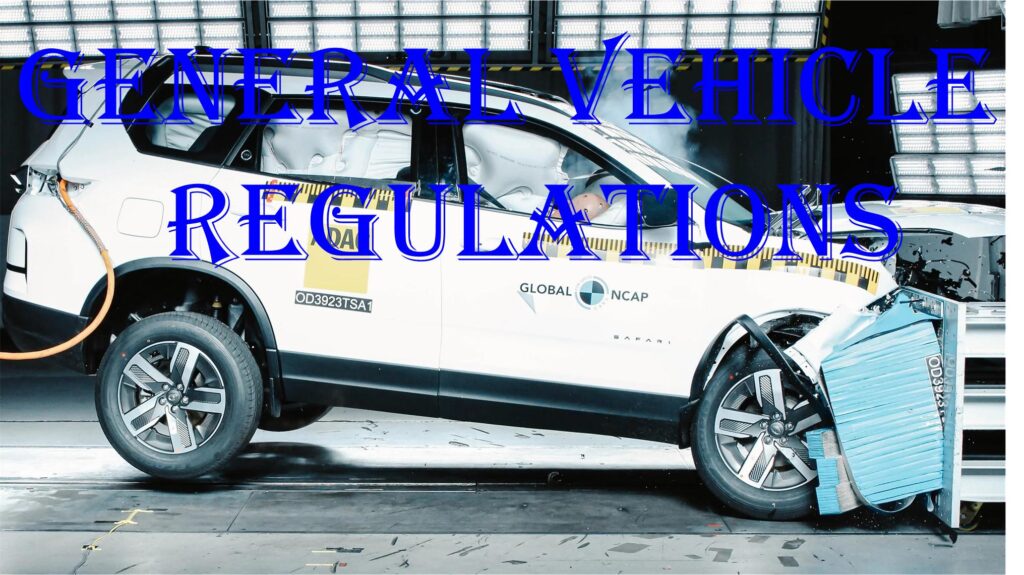
Slide 2. General Vehicle Regulations.
- What do the General Vehicle Regulations regulate?.
The General Vehicle Regulations are a technical and legal manual that establishes the characteristics that a vehicle must meet in order to be driven on public roads.
The regulations establish provisions covering everything from braking and lighting systems to pollutant emissions. These regulations affect any person or company that owns, drives, or manufactures a car. They are an essential component of road safety and sustainability.
Each country has its own General Vehicle Regulations. Below are the regulations of the European Union.
The main aspects regulated by the European Union’s General Vehicle Regulations are as follows.
- Mechanical safety and mandatory systems.
The regulations require all vehicles to have effective braking systems. Current regulations establish minimum response and effectiveness parameters, thus ensuring that any vehicle can stop safely.
In addition, it regulates the installation and approval of components such as ABS brakes, brake assist systems, and electronic stability control (ESP), among others.
- Structural design and occupant protection.
The vehicle structure is subject to specific regulations. It is imperative that it not only functions, but also provides protection. Therefore, the regulations require the implementation of programmed deformation zones, the use of resistant materials in the manufacture of car bodies, and the inclusion of passive safety systems, such as airbags and three-point seat belts. All of this is designed to increase the chances of escaping unharmed in the event of an accident.
- Environmental standards and lighting.
- Emissions control and sustainability.
The General Vehicle Regulations establish clear limits for pollutant emissions. Thanks to the implementation of control systems, such as particle filters and catalytic converters, a significant reduction in the environmental impact associated with road traffic has been achieved. In addition, it complies with the most rigorous European regulations, such as the Euro 6 and upcoming Euro 7 standards, and continues to evolve towards cleaner technologies.
- Regulated lighting to prevent accidents.
It is important to note that headlights, turn signals, and brake lights must meet specific requirements. Various parameters, such as the type of light, its intensity, color, and behavior, are meticulously monitored. All measures have been implemented with the purpose of preventing glare and ensuring the visibility of the vehicle at all times.
- Vehicle approvals and modifications.
- Approval of new models.
Before a new car is available on the market, it must undergo a rigorous technical approval process. This ensures that the model complies with all safety, emissions, design, and equipment requirements. Features such as automatic braking, blind spot sensors, and parking aids are already covered by many of these current requirements.
- Vehicle classification.
Defines the different categories of vehicles and their characteristics.
- Documentation.
Establishes the documents that vehicles must carry, such as the registration certificate and the MOT card.
The MOT test assesses several aspects of a vehicle to ensure it’s safe roadworthy and exhaust emissions.
- Registration.
Contains the rules on registration, change of ownership, deregistration, and temporary driving permits.
- License plates.
Establishes the technical specifications and content of license plates, including the prohibition of decorations or advertising.
- Changes after registration.
If an electric motor is installed in a classic vehicle or the suspension is modified, it will be necessary to obtain the corresponding administrative authorization and pass a technical inspection. These modifications must be duly notified, and the vehicle must continue to comply with the required standards. The main objective of these improvements is to ensure that they do not compromise safety or violate current legislation.
- Regulations that evolve over time.
The General Vehicle Regulations are not a static document. They evolve over time to adapt to technological innovations and current environmental challenges. Without them, driving on the road would be chaotic and dangerous.
When I was a fleet manager, there was a change in the regulations for rearview mirrors on certain trucks, and all the mirrors had to be changed to comply with the new legislation.
- Implications for fleet management.
The main consequence of not complying with the General Vehicle Regulations is financial penalties, failure to pass the MOT, and even immobilization of the vehicle, with the cost and time that the vehicle is unavailable for service.
It is important to be aware of the modifications and changes that occur in the General Vehicle Regulations over time and how they affect the vehicles in the fleet.
As this is a legal and regulatory issue, it is advisable to hire an external company specializing in this area to notify us when there is a new regulation or modification that affects the vehicles in the fleet.
Although this is a very important issue, fleet managers do not have to devote much time to it, as there are other more important fleet management activities.
If your fleet is very large, you can have an employee perform this task.
If you are planning to modify, install, or change anything in your vehicle, you must consult the Vehicle Modification Manual. This manual is an essential reference document, as it provides detailed guidance on the procedures and descriptions required to legalize any changes made to a vehicle.
Its main purpose is to ensure that all modifications comply with current safety standards and are legally recognized. The manual classifies modifications using specific codes and provides a comprehensive list of the steps and documents required for each type of modification.
Slide 3. Thank you for your time.
The class has developed what the General Vehicle Regulations are and what they regulate, as well as their implications for fleet management, see you soon.
Bibliography.
https://www.autopista.es/noticias-motor/reglamento-general-vehiculos-dgt-que-es-regula_312523_102.html
https://www.cea-online.es/blog/423-en-que-ha-cambiado-el-reglamento-general-de-vehiculos
The price of the training is 250 euros.
The training is asynchronous online, you can do it at your own pace, whenever and from wherever you want, you set the schedule.
Classes are video recorded.
Start date: The training can be started whenever you want. Once payment is made, you have access to the training.
The training is in English, subtitles and syllabus avalaible.
Other subtitles and video syllabus available: Arabic, Chinese, French, German, Indonesian, Italian, Japanese, Korean, Persian, Portuguese, Russian, Spanish, Thai, Turkish, Vietnamese.
All syllabus has been developed by the teacher.
Fill out the following form to receive course information, or write an email to:
Contact.
- José Miguel Fernández Gómez.
- Email: info@advancedfleetmanagementconsulting.com
- Mobile phone: +34 678254874 Spain.
Course Features.
- The course is aimed at: managers, middle managers, fleet managers, any professional related to electric vehicles, and any company, organization, public administration that wants to switch to electric vehicles.
- Schedule: at your own pace, you set the schedule.
- Duration: 28 hours.
- Completion time: Once you have started the course you have 6 months to finish it.
- Materials: english slides and syllabus for each class in PDF.
- If you pass the course you get a certificate.
- Each class has a quiz to take.
- English language, subtitles and syllabus.
- Other subtitles and video syllabus available: Arabic, Chinese, French, German, Indonesian, Italian, Japanese, Korean, Persian, Portuguese, Russian, Spanish, Thai, Turkish, Vietnamese.
-
Start date: The course can be started whenever you want. Once payment is made, you have access to the course.
Price.
- 250 euros.
-
You can pay by bank transfer, credit card, or PayPal.
Goals.
- Know the most important aspects to take into account when electrifying a fleet of vehicles.
- Learn about electric vehicle technology.
- Know the polluting emissions that occur when a fleet of vehicles is electrified.
- Know what technologies are viable to electrify a fleet of vehicles.
- Learn about real cases of vehicle fleet electrification.
- Know the history of the electric vehicle.
Syllabus.
Electric vehicle technology.
- History of the electric vehicle.
- Electric vehicle technology.
- Fundamentals of the electric vehicle battery.
- Other electric vehicle battery storage technologies.
- Electric vehicle battery components
- Battery Management System-BMS.
- Electric vehicle battery degradation.
- Impact of ambient temperature on battery performance.
- Fundamentals of the electric vehicle motor.
- Types of electric motors and their relationship with rare earths.
- An electric vehicle inverter: What it is and what it is used for.
- The use of rare earths in electric vehicles.
- Electric vehicle tires.
Electric vehicle battery.
- What is and is not covered by the electric vehicle battery warranty.
- The battery passport.
- A second life for electric vehicle batteries
Electric vehicle battery fire.
- Prevention, control, and extinguishing of electric vehicle battery fires.
- Fire safety regulations for electric vehicle batteries.
Charging Points: Problems and Solutions.
- Problems with electric car charging points and their possible solutions
- Copper theft from electric vehicle chargers
- Cybersecurity at charging points
Polluting emissions from electric vehicles.
- Which emits more CO2, an electric car or a car with an internal combustion engine?
- Polluting emissions from brakes
Key aspects of fleet electrification.
- Fleet electrification with plug-in hybrids: Problem or solution?
- Fleet electrification with hydrogen vehicles.
- Battery replacement: A feasible solution for urban fleets.
- The Hertz electrification case.
- The Huaneng case, the world’s first electrified and autonomous mining fleet.
- A real-life taxi case: Three true stories of electrification for economic reasons.
- The second life of the electric vehicle battery at Rome-Fiumicino Leonardo Da Vinci Airport.
- Consequences for the vehicle fleet if an electric vehicle brand goes bankrupt.
- The electric vehicle brands most likely to break down due to high temperatures.
- How to avoid premature obsolescence of electric vehicles in the fleet.
- Mileage manipulation to void the warranty.
- E-fuels and synthetic fuels are not an alternative for decarbonizing the vehicle fleet.
- The importance of electricity tariffs in reducing electric vehicle costs.
- Electric vehicles, artificial intelligence, and electricity demand.
Electric vehicle insurance.
- The price of electric vehicle insurance.
- Electric vehicle insurance and advanced driver assistance systems (ADAS).
Driving an electric vehicle.
- Electric vehicles cause more motion sickness than gasoline-powered vehicles.
- One-pedal driving: Risk of accidents.
Training teacher.
José Miguel Fernández Gómez is the manager of Advanced Fleet Management Consulting, a consulting company specialized in vehicle fleet management and the owner of the fleet management channel on YouTube AdvancedfleetmanagementTube.
Since 2007 I have been working in fleet management consultancy and training for all types of companies, organizations and public administrations. With this course I want to make my experience and knowledge acquired during my work and academic career in this discipline available to my clients.
I carry out consulting projects related to vehicle fleet management and collaborate with companies developing products/services in this market. I have worked at INSEAD (France), one of the best business schools in the world, as a Research Fellow at the Social Innovation Centre-Humanitarian Research Group.
I carried out consulting and research activities in a project for the United Nations refugee organization (UNHCR), optimizing the size and management of the activities of the vehicle fleet, which this organization has distributed throughout the world (6,500 vehicles).
I worked as a fleet manager for five years, for Urbaser, which managed the street cleaning service in Madrid (Spain). I managed a fleet of 1,000 vehicles, made up of various technologies and types of vehicles such as: heavy and light vehicles, vans, passenger cars or sweepers.
I have completed all my academic degrees at the Polytechnic University of Madrid, one of the best universities in Spain, my academic training is as follows:
I hold a PhD in Industrial Engineering, with international mention, since I carried out research stays at the University of Liverpool (UK) and at the Royal Institute of Technology-KTH (Sweden).
I am also an Industrial Engineer (Industrial Management) and an Mechanical Engineer, and I completed a Master’s Degree in Operations Management, Quality and Technological Innovation (Cepade) and another Master’s Degree in Industrial Management (UPM).
I have publications in indexed magazines and presentations at international industrial engineering conferences.
Cancellations and penalties.
Once the course has started, the amount will not be refunded.