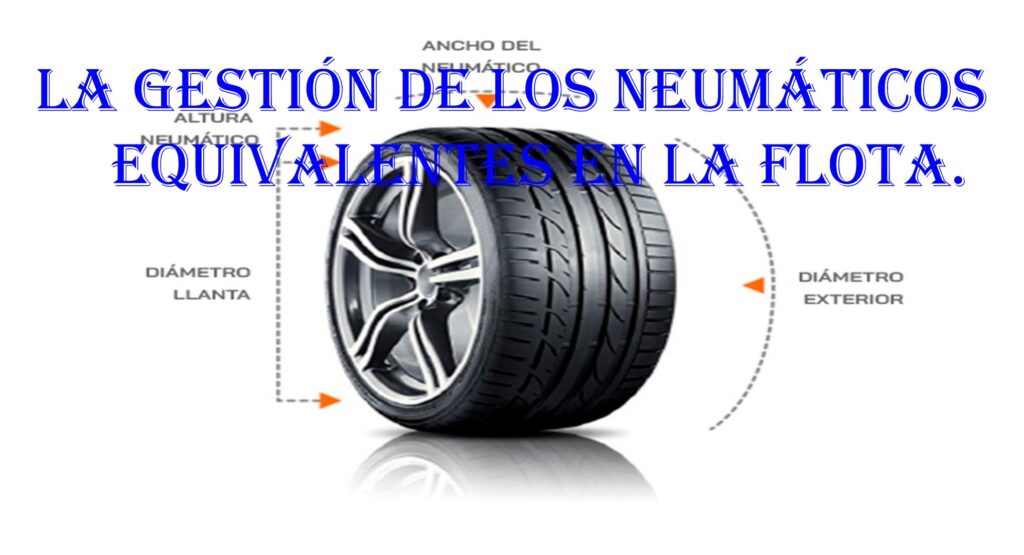
The class develops what equivalent tires are for a vehicle and the implications for fleet management.
Slide 2. Equivalent tires for a vehicle.
- What is considered an equivalent tire?.
When replacing vehicle tires, one viable alternative is to use equivalent tires, which is a valid option as long as certain established technical parameters are met. This type of tire offers greater flexibility without compromising the safety or legality of the vehicle.
Equivalent tires have slightly different dimensions from the vehicle’s original tires, but they are fully suitable for use in accordance with current legislation. For this to be the case, certain technical requirements must be met to ensure compatibility.
The case of Spain is developed below, but the situation is the same or similar in any country.
- Conditions for legality.
The regulations governing equivalent tires are set out in the MOT Station Inspection Procedure Manual.
Equivalent tires must comply with the following.
- The load index must be equal to or greater than the original.
- The maximum speed rating must be equal to or greater than that specified in the technical data sheet.
- The difference in total diameter from the original cannot exceed +-3%.
- The minimum tread depth must be maintained at least 1.6 mm, as required by law.
- There must be no interference between any part of the vehicle and the tire, for example, if it rubs against the fender, even if a tire is equivalent, you cannot mount it on the car if it does not comply with this condition.
A +-3% change in tire diameter has very little effect on a vehicle’s dynamics and safety.
Replacing tires is prohibited when it involves the risk of interference with other parts of the vehicle.
If all these points are met, the tires can be considered equivalent and will not require re-approval to pass the MOT.
- Effects on vehicle performance.
Choosing equivalent tires is not just a matter of dimensions. It can also influence the car’s performance, fuel consumption, and safety.
- Actual speed and indicated speed.
A difference in diameter can alter the speedometer reading.
If the tire is smaller, the car will go slower than indicated, since the total diameter of the wheel is smaller than the factory-approved diameter, and it travels fewer centimeters per revolution.
If it is larger, the car will go faster than indicated, as the diameter of the wheel is greater, covering more centimeters in one revolution.
The accuracy of assistance systems such as cruise control may be affected by this condition.
- The width of the tire influences the car’s performance.
The width of the tire directly affects traction and braking distance.
- Wider.
Advantages.
- They grip better on curves.
- Braking distance will be shorter since there is more contact surface.
- More stability while driving.
Disavantages.
- It tends to be more expensive.
- It consumes more fuel.
- It makes a little more noise when driving.
- Narrower tire.
Advantages.
- It generates slightly less noise.
- It is slightly more economical.
- It consumes less energy because it has less friction with the ground.
Disavantages.
- It has less grip.
- Cornering performance is somewhat less stable compared to a wider tire.
- Longer braking distance
- The tire profile.
As with tire width, changing the tire profile will also alter the vehicle’s performance, as will the sidewall height, measured in millimeters.
-
- More profile.
More comfortable ride, but less feedback at the wheel.
-
- Less profile.
You feel the road better, but at the expense of passenger comfort.
- How do I know if I can fit equivalent tires?.
To determine tire equivalence, we recommend using an equivalence calculator available on many specialized websites. To determine compliance with legal requirements, you need to enter the original and new measurements into the system.
It is also recommended to check the comments section in the vehicle’s technical specifications, where alternative sizes that have already been approved are sometimes indicated.
However, if you have any doubts, it is recommended to consult the vehicle manufacturer directly, as they have the appropriate tire equivalence table for your vehicle.
- Precautions before installing equivalent tires.
Even if they are within the legal limits, it is advisable to follow these recommendations.
-
- Ensure that there is no mechanical interference.
-
- Check that the steering, braking system, and safety sensors are not affected.
- Why fit equivalent tires to a fleet?.
The main reasons for fitting equivalent tires to a fleet are.
- Cost.
The main reason for a vehicle fleet is to reduce tire costs if we find an equivalent tire that is cheaper than the original.
- Reduction in fuel consumption and pollutant emissions.
Although the main reason for fitting equivalent tires is cost, it is recommended to fit tires that are narrower than the original ones to reduce fuel consumption and pollutant emissions because they have a smaller contact surface and lower rolling resistance.
- Increased performance.
Increasing the width of the tire increases the grip and stability of the vehicle, although it also increases fuel consumption and pollutant emissions.
This can be useful on slippery terrain or when there is a lack of grip.
- Aesthetics.
Most equivalent tire changes in private vehicles are made to improve the aesthetics of the vehicle, in a fleet it makes no sense.
- Steps for fitting equivalent tires.
In a vehicle fleet, 20% of tire profiles generate 80% of the total cost of tires.
When I was a fleet manager for the street cleaning service in Madrid, I had a fleet of 1,000 vehicles of all types, including passenger cars, pickups, light trucks, industrial vehicles, sweepers, etc.
The most numerous vehicles in the fleet were the Toyota Hilux and Nissan Cabstar, and the trucks that had the same tire profile.
Only two tire profiles, the 195/70 R15 for the Toyota Hilux and Nissan Cabstar, and the 315 70 R22.5 for the trucks, accounted for 80% of the tires changed.
In one year, 1,300 tires were changed at a total cost of €500,000.
1º. Know the profiles of the most commonly used tires.
It is advisable to have a database of replaced tires with information such as profile, cost, reason for replacement, etc.
If there is no database, it is important to know which vehicle models are the most numerous in the fleet, and therefore which tire profiles are replaced most often.
In passenger car or SUV fleets, tire profiles may vary, although they usually have similar tires.
In truck fleets, all trucks of different brands usually have the same tire profile.
In public machinery, airport, port, and special vehicle fleets, the tire profile varies greatly.
2º. Know the profiles of equivalent tires.
This information can be found in the vehicle’s technical specifications or on websites for equivalent tires.
3º. Find equivalent tires that are more economical than the originals.
Ask our tire supplier or tire manufacturers.
4º. Choose the equivalent tire that complies with regulations.
Profiles with a smaller width than the original are recommended because they consume less fuel and produce fewer pollutant emissions.
5º. Change the tire at your own or an external workshop.
It is recommended to work with workshops specializing in tires or with tire manufacturers.
- Implications for fleet management.
In a vehicle fleet, the cost of tires accounts for between 3% and 5% of the total cost of the fleet. A change of +-3% in tire diameter has very little effect on vehicle dynamics and safety, and using equivalent tires can achieve significant cost savings.
The main consequence is a reduction in fleet tire costs, fuel consumption, and pollutant emissions.
If you have your own workshop, you must instruct the workshop manager to install equivalent tires on the vehicles.
If you do not have your own workshop, you must instruct the external workshop to install equivalent tires on the vehicles.
You must also instruct the driver or worker to take the vehicle to the external workshop.
If a larger tire has been installed, increasing the diameter of the original tire, the driver must be informed that the speed indicated by the car is lower than the actual speed, although this variation is very small.
In summary, equivalent tires are an excellent alternative for reducing costs. However, it is essential to be aware of their legal and technical limitations to avoid compromising the safety and certification of the vehicle.
Always choose models that comply with the +-3% margin and ensure that the repair shop is familiar with this type of change. This will prevent any complications during the MOT or on the road with the traffic authorities.
Slide 3. Thank you for your time.
The class has developed what equivalent tires are for a vehicle and the implications for fleet management, see you soon.
Bibliography.
https://www.autopista.es/noticias-motor/neumaticos-equivalentes-que-son-sirven-ecn_311037_102.html
The price of the training is 250 euros.
The training is asynchronous online, you can do it at your own pace, whenever and from wherever you want, you set the schedule.
Classes are video recorded.
Start date: The training can be started whenever you want. Once payment is made, you have access to the training.
The training is in English, subtitles and syllabus avalaible.
Other subtitles and video syllabus available: Arabic, Chinese, French, German, Indonesian, Italian, Japanese, Korean, Persian, Portuguese, Russian, Spanish, Thai, Turkish, Vietnamese.
All syllabus has been developed by the teacher.
Fill out the following form to receive course information, or write an email to:
Contact.
- José Miguel Fernández Gómez.
- Email: info@advancedfleetmanagementconsulting.com
- Mobile phone: +34 678254874 Spain.
Course Features.
- The course is aimed at: managers, middle managers, fleet managers, any professional related to electric vehicles, and any company, organization, public administration that wants to switch to electric vehicles.
- Schedule: at your own pace, you set the schedule.
- Duration: 28 hours.
- Completion time: Once you have started the course you have 6 months to finish it.
- Materials: english slides and syllabus for each class in PDF.
- If you pass the course you get a certificate.
- Each class has a quiz to take.
- English language, subtitles and syllabus.
- Other subtitles and video syllabus available: Arabic, Chinese, French, German, Indonesian, Italian, Japanese, Korean, Persian, Portuguese, Russian, Spanish, Thai, Turkish, Vietnamese.
-
Start date: The course can be started whenever you want. Once payment is made, you have access to the course.
Price.
- 250 euros.
-
You can pay by bank transfer, credit card, or PayPal.
Goals.
- Know the most important aspects to take into account when electrifying a fleet of vehicles.
- Learn about electric vehicle technology.
- Know the polluting emissions that occur when a fleet of vehicles is electrified.
- Know what technologies are viable to electrify a fleet of vehicles.
- Learn about real cases of vehicle fleet electrification.
- Know the history of the electric vehicle.
Syllabus.
Electric vehicle technology.
- History of the electric vehicle.
- Electric vehicle technology.
- Fundamentals of the electric vehicle battery.
- Other electric vehicle battery storage technologies.
- Electric vehicle battery components
- Battery Management System-BMS.
- Electric vehicle battery degradation.
- Impact of ambient temperature on battery performance.
- Fundamentals of the electric vehicle motor.
- Types of electric motors and their relationship with rare earths.
- An electric vehicle inverter: What it is and what it is used for.
- The use of rare earths in electric vehicles.
- Electric vehicle tires.
Electric vehicle battery.
- What is and is not covered by the electric vehicle battery warranty.
- The battery passport.
- A second life for electric vehicle batteries
Electric vehicle battery fire.
- Prevention, control, and extinguishing of electric vehicle battery fires.
- Fire safety regulations for electric vehicle batteries.
Charging Points: Problems and Solutions.
- Problems with electric car charging points and their possible solutions
- Copper theft from electric vehicle chargers
- Cybersecurity at charging points
Polluting emissions from electric vehicles.
- Which emits more CO2, an electric car or a car with an internal combustion engine?
- Polluting emissions from brakes
Key aspects of fleet electrification.
- Fleet electrification with plug-in hybrids: Problem or solution?
- Fleet electrification with hydrogen vehicles.
- Battery replacement: A feasible solution for urban fleets.
- The Hertz electrification case.
- The Huaneng case, the world’s first electrified and autonomous mining fleet.
- A real-life taxi case: Three true stories of electrification for economic reasons.
- The second life of the electric vehicle battery at Rome-Fiumicino Leonardo Da Vinci Airport.
- Consequences for the vehicle fleet if an electric vehicle brand goes bankrupt.
- The electric vehicle brands most likely to break down due to high temperatures.
- How to avoid premature obsolescence of electric vehicles in the fleet.
- Mileage manipulation to void the warranty.
- E-fuels and synthetic fuels are not an alternative for decarbonizing the vehicle fleet.
- The importance of electricity tariffs in reducing electric vehicle costs.
- Electric vehicles, artificial intelligence, and electricity demand.
Electric vehicle insurance.
- The price of electric vehicle insurance.
- Electric vehicle insurance and advanced driver assistance systems (ADAS).
Driving an electric vehicle.
- Electric vehicles cause more motion sickness than gasoline-powered vehicles.
- One-pedal driving: Risk of accidents.
Training teacher.
José Miguel Fernández Gómez is the manager of Advanced Fleet Management Consulting, a consulting company specialized in vehicle fleet management and the owner of the fleet management channel on YouTube AdvancedfleetmanagementTube.
Since 2007 I have been working in fleet management consultancy and training for all types of companies, organizations and public administrations. With this course I want to make my experience and knowledge acquired during my work and academic career in this discipline available to my clients.
I carry out consulting projects related to vehicle fleet management and collaborate with companies developing products/services in this market. I have worked at INSEAD (France), one of the best business schools in the world, as a Research Fellow at the Social Innovation Centre-Humanitarian Research Group.
I carried out consulting and research activities in a project for the United Nations refugee organization (UNHCR), optimizing the size and management of the activities of the vehicle fleet, which this organization has distributed throughout the world (6,500 vehicles).
I worked as a fleet manager for five years, for Urbaser, which managed the street cleaning service in Madrid (Spain). I managed a fleet of 1,000 vehicles, made up of various technologies and types of vehicles such as: heavy and light vehicles, vans, passenger cars or sweepers.
I have completed all my academic degrees at the Polytechnic University of Madrid, one of the best universities in Spain, my academic training is as follows:
I hold a PhD in Industrial Engineering, with international mention, since I carried out research stays at the University of Liverpool (UK) and at the Royal Institute of Technology-KTH (Sweden).
I am also an Industrial Engineer (Industrial Management) and an Mechanical Engineer, and I completed a Master’s Degree in Operations Management, Quality and Technological Innovation (Cepade) and another Master’s Degree in Industrial Management (UPM).
I have publications in indexed magazines and presentations at international industrial engineering conferences.
Cancellations and penalties.
Once the course has started, the amount will not be refunded.