The class develops where to put new tires for changing, and the implications for fleet management.
Slide 2. Changing Tires.
Tires are one of the vehicle components that are often forgotten, even though they are vital in terms of active safety. After all, they are the vehicle’s link to the road, so poor maintenance can have disastrous consequences for the driver, road users, pedestrians, and cyclists.
It is unusual to change all four tires at once, as those mounted on the drive axle wear out faster. This is completely normal, as the forces exerted on the surface of engine-driven tires are much greater than those affecting passively rotating tires.
There’s a common misconception among drivers when it comes to fitting a new pair of tires and leaving another pair still usable on the vehicle: the false belief that new tires should be fitted to the front axle of front-wheel-drive vehicles, when in reality they should always be fitted to the rear axle. This misunderstanding affects not only private drivers but also professionals in the sector, posing a risk to vehicle safety.
Some drivers and professionals argue that new tires should be placed on the front axle.
- This is the axle that bears the most weight in front-wheel drive vehicles.
- This is where the steering system is located, so better grip on this axle could improve maneuverability.
Therefore, whenever two tires are replaced, the new ones should be placed on the rear axle and the old ones on the front. If the front tires are also in poor condition, it is advisable to replace them completely.
Although some workshops may suggest otherwise, this recommendation is supported by tests and studies that show it increases vehicle stability and reduces the risk of accidents.
- Where to install the new tires.
Ideally, all four tires should be replaced at the same time, as this ensures a balanced ride between the two axles. However, if this were done, in addition to being more expensive, the tires not on the drive axle would sometimes have less wear, so they would be replaced prematurely.
The priority when changing tires is not to improve traction or braking, but to ensure the vehicle’s stability in curves or on pavements with poor grip.
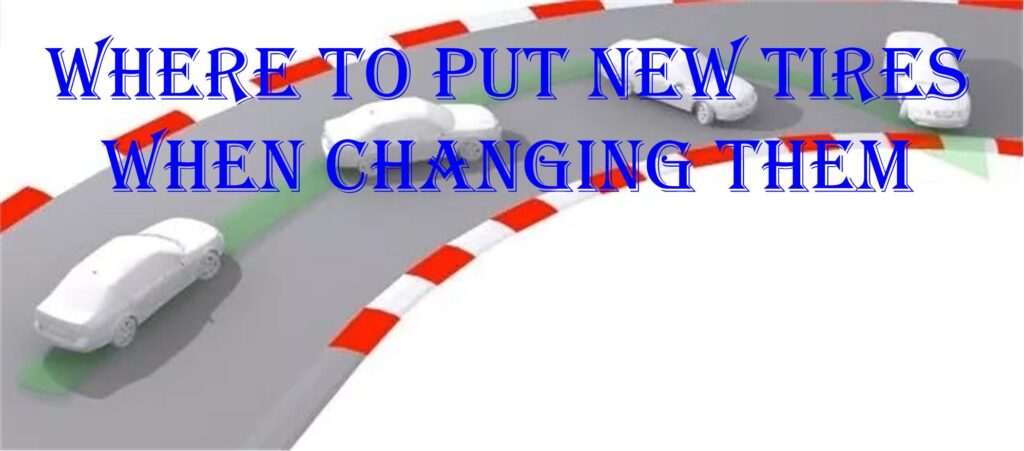
If the most worn tires are placed in the rear, the vehicle is more likely to lose control in curves or on slippery surfaces, causing oversteer. This phenomenon occurs when the rear tires spin and is difficult to control, as the rear of the vehicle moves to the outside of the intended trajectory.
On the other hand, having newer tires on the rear axle provides a safer and more predictable response, helping the driver maintain control in critical situations, such as tight turns or slippery surfaces.
This recommendation applies to any type of drive: front-, rear-, or all-wheel drive. Although some may think that, on a rear-wheel drive vehicle, new tires should be placed on the rear axle for grip, studies show that, in extreme situations, stability is more important than traction.
Even in 4×4 vehicles, where power is distributed between all four wheels, rear axle grip is still critical to prevent a sudden loss of control.
- Track tests: the effects of a poor choice.
To test these effects, tests were conducted with three identical vehicles equipped with tires in different conditions:
- New tires on the rear axle and used tires on the front.
- New tires on the front axle and used tires on the rear.
- A single new tire on the right front wheel, with the rest worn.
The results were overwhelming. In the first configuration, the vehicle maintained predictable behavior with a slight tendency toward understeer, which can be easily corrected by releasing the accelerator.
In the second configuration, with new tires on the front axle, stability disappeared. As speed increased in a wet corner, the rear axle abruptly lost grip, causing oversteer that was difficult to control.
In the third configuration, with a single new tire on one front wheel, the results were even more alarming. Depending on the direction of the turn, the vehicle reacted in opposite ways: in a right turn, the response was stable, but in a left turn, the difference in grip between the tires caused a sudden and unpredictable loss of control.
- Understeer is easier for most drivers to correct than oversteer.
- Oversteer.
Oversteer is a dangerous situation because most drivers are not trained to react correctly. It can occur when swerving around an obstacle or braking on a wet corner, and correcting it requires reflexes and experience.
Oversteer requires fighting our instincts. It occurs when the rear axle loses grip in a turn and the vehicle turns more than the steering indicates, i.e., spins out.
Most drivers tend to brake in these types of situations because they are scared. By doing so, we take even more weight off the rear axle, which further reduces its grip and makes the situation worse.
To correct oversteer, it is essential to countersteer, that is, turn the steering wheel in the opposite direction of the skid. At the same time, gently lift off the accelerator to regain traction, but without braking abruptly. It is crucial to remain calm and avoid sudden steering movements.
By fitting new tires to the rear axle, we reduce the risk of oversteer.
- Understeer.
Understeer occurs when the front wheels lose grip in a corner and the vehicle doesn’t enter it properly. In this case, instinct helps us, as the first thing we do when faced with any problem is to ease off the accelerator and brake.
By doing so, we transfer weight to the front axle, which increases grip and reduces understeer; that is, the vehicle turns less than we indicate with the steering wheel.
It’s not a desirable situation, but it’s much easier to correct than oversteer.
- Tire rotation.
In front-wheel drive vehicles, the front wheels wear out faster than the rear wheels, in some cases almost twice as much. If we change the front wheels and install new ones on the front, since the rear wheels wear more slowly, we’ll end up with two tires with more wear on the rear wheels and, in addition, with much drier rubber due to their age. By moving the rear wheels forward, they will wear out faster and we’ll have to change them sooner, so in less time we’ll have four wheels with a more similar age and in better condition.
What we should do is change the two most worn ones, which will most likely be the front ones, and move the ones that were less worn to the front axle, placing the new ones we just purchased on the rear.
- Less risk of aquaplaning.
Aquaplaning causes the vehicle to literally float on the water on the road. It occurs when the tire doesn’t have time to evacuate the water it passes over. Most vehicles have the engine in the front, so the front axle bears more weight, which increases the pressure against the road surface. If we mount new tires on the front axle and leave the worn ones at the rear, in case of rain we will have a front axle with tires that evacuate water better and, because they have more weight on them, they will be less likely to float.
The opposite happens on the rear axle, which has tires with less tread depth and, because they have less weight, are more likely to float. A vehicle with new tires on the front axle and worn tires on the rear axle behaves very unstable and is dangerous in wet conditions.
- Tire punctures and blowouts.
Although we may think otherwise, a rear tire puncture is more dangerous than a front tire. If a rear tire bursts, it’s easier to lose control of the vehicle than if a front tire does. Older tires are more prone to punctures and blowouts.
- Implications for fleet management.
The main consequence of fitting new tires on the rear axle is increased vehicle safety and stability, especially in low-grip situations or when it’s raining.
In Spain, by law, the minimum tire tread height is 1.6 millimeters. However, if we notice that the vehicle is performing worse or lacks traction or stability on wet surfaces, it is recommended to change the tire even if it has a tread depth greater than 1.6 millimeters. It is also recommended to change the tire if it shows uneven wear, damage to the sidewalls, etc.
There is technology to prevent or correct oversteer and understeer, such as Electronic Stability Control. This is an active safety system that helps prevent skidding and loss of vehicle control. It works by constantly monitoring the vehicle’s trajectory and, if it detects a deviation between the intended and actual direction, it applies the brakes individually to each wheel to correct the trajectory and prevent skidding. In Europe, it has been mandatory for all vehicles since 2014.
A procedure must be implemented that requires new tires to always be mounted on the rear axle, and this must be submitted to our workshop manager.
If the workshop is external, they must be instructed to always mount the tires on the rear axle.
A bad practice is to change the tire in the same position as the replacement, and also not to change the other tire on the axle. It is always recommended to change both tires on the same axle at the same time.
Drivers should be trained in how to correct oversteer and understeer, both theoretically and practically on the track, and should be given a tire inspection before driving.
In short, new tires should preferably be placed on the rear axle to maximize safety and minimize the risk of loss of control, especially in low-grip conditions.
Slide 3. Thank you for your time.
The class has developed where to put new tires for changing, and the implications for fleet management, see you soon.
Bibliography.
https://www.autocasion.com/actualidad/reportajes/las-ruedas-nuevas-se-montan-delante-o-detras/
https://www.autopista.es/noticias-motor/eterna-duda-en-donde-debo-colocar-ruedas-nuevas-cambiarlas-expertos-responden_314299_102.html
https://www.carwow.es/editorial/consejos-conductores/consejos-conduccion/donde-colocar-neumaticos-nuevos-error-conductores#gref
The price of the training is 250 euros.
The training is asynchronous online, you can do it at your own pace, whenever and from wherever you want, you set the schedule.
Classes are video recorded.
Start date: The training can be started whenever you want. Once payment is made, you have access to the training.
The training is in English, subtitles and syllabus avalaible.
Other subtitles and video syllabus available: Arabic, Chinese, French, German, Indonesian, Italian, Japanese, Korean, Persian, Portuguese, Russian, Spanish, Thai, Turkish, Vietnamese.
All syllabus has been developed by the teacher.
Fill out the following form to receive course information, or write an email to:
Contact.
- José Miguel Fernández Gómez.
- Email: info@advancedfleetmanagementconsulting.com
- Mobile phone: +34 678254874 Spain.
Course Features.
- The course is aimed at: managers, middle managers, fleet managers, any professional related to electric vehicles, and any company, organization, public administration that wants to switch to electric vehicles.
- Schedule: at your own pace, you set the schedule.
- Duration: 27 hours.
- Completion time: Once you have started the course you have 6 months to finish it.
- Materials: english slides and syllabus for each class in PDF.
- If you pass the course you get a certificate.
- Each class has a quiz to take.
- English language, subtitles and syllabus.
- Other subtitles and video syllabus available: Arabic, Chinese, French, German, Indonesian, Italian, Japanese, Korean, Persian, Portuguese, Russian, Spanish, Thai, Turkish, Vietnamese.
-
Start date: The course can be started whenever you want. Once payment is made, you have access to the course.
Price.
- 250 euros.
-
You can pay by bank transfer, credit card, or PayPal.
Goals.
- Know the most important aspects to take into account when electrifying a fleet of vehicles.
- Learn about electric vehicle technology.
- Know the polluting emissions that occur when a fleet of vehicles is electrified.
- Know what technologies are viable to electrify a fleet of vehicles.
- Learn about real cases of vehicle fleet electrification.
- Know the history of the electric vehicle.
Syllabus.
- History of electric vehicle.
- Battery electric vehicle.
- History of the lithium ion battery.
- Types of electric vehicle batteries.
- New electric vehicle battery materials.
- Other storage technologies of electric vehicle batteries.
- Battery components.
- Battery Management System-BMS.
- The use of rare earths in the electric vehicle.
- Fundamentals of the electric motor.
- Types of electric motors and their relationship to rare earths.
- Electric vehicle inverter: what it is and what it is used for.
- Battery degradation loss of autonomy.
- What is covered and not covered by the electric vehicle battery warranty.
- Battery passport.
- Battery fire of the electric vehicle.
- Causes, stages and risks of battery fire.
- Real cases of electric vehicle fire.
- Electric vehicle battery fire extinguishment.
- Measures to prevent, extinguish and control electric vehicle fires.
- Fire safety regulations for electric vehicle batteries.
- Impact of ambient temperature on battery performance.
- The electric vehicle brands most likely to breakdown due to high temperatures.
- Which emmits more Co2, an electric car or a car with an internal combustion engine.
- Plug-in electric hybrids, a solution or an obstacle to electrify the vehicle fleet?.
- Fleet electrification with hydrogen vehicles.
- Cybersecurity of charging points.
- The theft of copper in electric vehicle chargers.
- Incidents at electric car charging points and their possible solutions.
- Batery swapping.
- The second life of the battery of the EV at Rome airport.
- The tires of electric vehicles.
- Electric vehicle, artificial intelligence, and electricity demand.
- The case of Hertz electrification.
- The case of Huaneng: The world’s first electrified and autonomous mining fleet
- Consequences on the vehicle fleet of an electric vehicle brand going bankruptcy.
- E-fuels and synthetic fuels are not an alternative to decarbonize the vehicle fleet.
- How to avoid premature obsolescence of the fleet’s electric vehicles.
- Polluting emissions from brakes.
- Mileage manipulation to extinguish warranty early on electric vehicles.
- The importance of the electricity tariff in reducing electric vehicle costs.
- Taxi reality: Three true stories of electrification for economy.
- Electric vehicles cause more motion sickness than gasoline vehicles.
- The cost of insurance for electric vehicles.
- Electric vehicle insurance and advanced driver assistance systems-ADAS.
- One-pedal driving: Risk of accidents.
Training teacher.
José Miguel Fernández Gómez is the manager of Advanced Fleet Management Consulting, a consulting company specialized in vehicle fleet management and the owner of the fleet management channel on YouTube AdvancedfleetmanagementTube.
Since 2007 I have been working in fleet management consultancy and training for all types of companies, organizations and public administrations. With this course I want to make my experience and knowledge acquired during my work and academic career in this discipline available to my clients.
I carry out consulting projects related to vehicle fleet management and collaborate with companies developing products/services in this market. I have worked at INSEAD (France), one of the best business schools in the world, as a Research Fellow at the Social Innovation Centre-Humanitarian Research Group.
I carried out consulting and research activities in a project for the United Nations refugee organization (UNHCR), optimizing the size and management of the activities of the vehicle fleet, which this organization has distributed throughout the world (6,500 vehicles).
I worked as a fleet manager for five years, for Urbaser, which managed the street cleaning service in Madrid (Spain). I managed a fleet of 1,000 vehicles, made up of various technologies and types of vehicles such as: heavy and light vehicles, vans, passenger cars or sweepers.
I have completed all my academic degrees at the Polytechnic University of Madrid, one of the best universities in Spain, my academic training is as follows:
I hold a PhD in Industrial Engineering, with international mention, since I carried out research stays at the University of Liverpool (UK) and at the Royal Institute of Technology-KTH (Sweden).
I am also an Industrial Engineer (Industrial Management) and an Mechanical Engineer, and I completed a Master’s Degree in Operations Management, Quality and Technological Innovation (Cepade) and another Master’s Degree in Industrial Management (UPM).
I have publications in indexed magazines and presentations at international industrial engineering conferences.
Cancellations and penalties.
Once the course has started, the amount will not be refunded.