
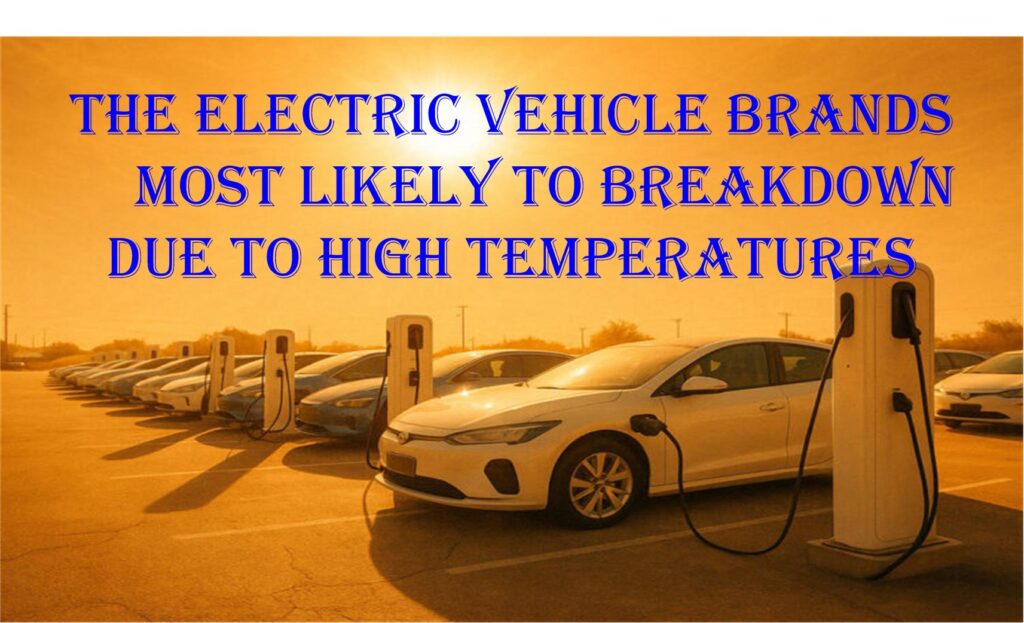
The class develops the electric vehicle manufacturers most likely to break down due to high temperatures, and the implications for fleet management.
Slide 2. The electric vehicle manufacturers most likely to break down due to high temperatures.
- Vehicle reliability.
Reliability has become a challenge for electric vehicles, especially during the summer season and high temperatures, which are more detrimental to these vehicles than to models equipped with other technologies. Currently, two brands are at a significant disadvantage in this regard, compared to the rest.
Reliability has become one of the main evaluation criteria for European consumers in their purchasing decision-making process. As all studies have confirmed, including that of the Organization of Consumers and Users (OCU), this factor even takes precedence over other factors traditionally considered more important, such as the price of the vehicles or the type of segment they belong to. The serious problems that have affected some manufacturers, especially in recent years and related to AdBlue tank and timing belt failures, have heightened concern.
In this sense, electric vehicles have also become a problem in recent years. As their number and sales grow, so does the uncertainty surrounding their potential breakdowns and failures, which have been less documented so far due to less experience and data collection given their newness. However, it is clear that heat represents a significant challenge for them.
- High temperatures penalize electric cars.
While high temperatures can cause potential breakdowns in any vehicle, this situation can be especially critical for electric cars during the summer. Temperatures above 35°C have a significant impact on the highly sensitive components of these vehicles.
The components that can fail are:
- The battery.
In the case of older vehicles or those with high mileage, it is especially important to consider that exposure to outside temperatures above 35°C can cause accelerated degradation of their internal cells. This situation can compromise the vehicle’s range and, consequently, increase the risk of experiencing critical failures that can leave the driver stranded on the road.
- The cooling system.
Working beyond its normal capacity increases the risk of failure due to overheating.
- Electronic control units-ECUs.
It is crucial to keep in mind that ECUs are extremely sensitive to heat, which can cause malfunctions or even the disruption of vital driving systems.
Given this reality, Carly, the leading global automotive diagnostics application and platform, has conducted an exhaustive analysis of the state of electric vehicles in Spain in 2025, revealing today which brands are more or less likely to experience critical failures due to their vulnerability to heat and high temperatures.
Carly offers an affordable solution for all drivers. The OBD2 scanner, in conjunction with the mobile application, makes it possible to perform a comprehensive diagnosis of the vehicle’s condition from your phone, regardless of the need for technical knowledge. There are different options on the market, like those offered by Carly.
Through this ranking, Carly aims to provide consumers with information so they can identify which brands require more rigorous preventative maintenance this season, helping them avoid more costly breakdowns over time.
- Electric vehicles most likely to break down due to high temperatures.
Below is the ranking provided by Carly, showing the risk of electric vehicle breakdowns in Spain in 2025.
-
- BMW: 73.03%.
- Tesla: 67.43%.
- Audi: 61.08%.
- Mini: 53.85%.
- Škoda: 45.95%.
- Volkswagen: 44.87%.
- SEAT: 38.66%.
- Hyundai: 8.4%.
- Citroën: 7.1%.
- Mercedes-Benz: 6.86%.
- Toyota: 6.2%.
- Peugeot: 2.3%.
- BMW and Tesla are negative surprises.
However, it’s worth mentioning that two manufacturers have generated an unfavorable impression. The first is Tesla, the most popular brand among electric vehicles and home to the two biggest bestsellers on the market, the Model 3 and Model Y. According to the analysis, 67.43% of this company’s vehicles experience breakdowns related to high temperatures.
However, even above Tesla is BMW, with a 73.03% risk of critical breakdowns in its electric models due to high heat. In third place is Audi with 61.08%.
Other brands, such as Mini and Škoda, also exceed 45%, revealing a pattern that could be related to the demanding thermal load these vehicles endure in summer.
The full ranking of brands also reveals unexpected results. Hyundai, Citroën, Mercedes-Benz, Toyota, and Peugeot are among the brands least likely to experience breakdowns during the summer. Peugeot, for example, has a mere 2.3% breakdown rate, indicating that, while they may not be the most popular brands in the electric segment, they are demonstrating enviable reliability under extreme conditions.
- Why do some brands have more breakdowns than others?.
The key to success could lie in the experience accumulated in the electric sector. Newer brands or those that have opted from the outset for an architecture specifically designed for electric vehicles, rather than simply adapting combustion models, seem to have developed more efficient systems to withstand high temperatures. Likewise, the quality of the materials used, the efficiency of the thermal management software, and the type of battery used must be considered.
In any case, discrepancies between brands are not only attributed to vehicle design or component quality, but also to the age and volume of each electric fleet in circulation. Firms with a longer history in the electric market, such as Tesla or BMW, have more units in intensive use and greater accumulated exposure to wear and tear, which increases the probability of failure. In contrast, brands that have recently introduced electric models or whose sales are still low show significantly lower rates of critical breakdowns.
Warning signs of vehicle overheating.
It’s important to note that not all vehicles are equipped with the same warning systems. In a Tesla Model 3/Y, the system will display a thermometer icon on the screen, accompanied by a text message stating “Battery is hot.”
In the case of an Audi e-tron, the message that may appear is: “Powertrain failure. See a workshop.” It’s imperative to be aware of these signs so you can act quickly.
- Implications for fleet management.
The main consequence of high temperatures is a breakdown with the cost of repair and downtime, meaning the vehicle cannot be used for service.
Battery cells can catch fire at temperatures of 60-65°C, so it is important to ensure the battery temperature is below 60°C.
Older vehicles or those with higher mileage are at greater risk of breakdown due to high temperatures, so preventive maintenance or battery checks must be performed more frequently than newer or low-mileage vehicles.
For brands such as Tesla, BMW, or Audi, more thorough monitoring and preventive maintenance or battery checks must be performed more frequently in high temperatures.
Many countries or geographical areas experience high temperatures for some months, and this must be taken into account when purchasing fleet vehicles.
For example, in southern Spain, temperatures exceed 35°C for 3-4 months, and during heat waves, they can reach 45°C.
Some brands are more at risk of breakdowns due to high temperatures for various reasons, as explained above. Therefore, it’s important to know the brands and models before purchasing vehicles for your fleet.
It is recommended to purchase vehicle makes and models that are least likely to break down due to high temperatures.
In certain countries with high temperatures, vehicle manufacturers modify their vehicles to better withstand the temperature and avoid breakdowns. It is advisable to know if the vehicle has this modification.
To find out which vehicle manufacturers are most likely to break down due to high temperatures, the following sources are available:
- Personal experience.
With makes and models in the fleet that have had breakdowns due to high temperatures.
- Internet search.
Perform an internet search for the vehicle model you want to purchase, including the most common breakdowns it has, especially those caused by high temperatures. There are specialized websites for after-sales, workshops, and vehicle repair that you can consult.
- Reports on the reliability of vehicle makes and models.
There are reports on the reliability of vehicle makes and models and the most common breakdowns, such as the one by Carly. It is advisable to search for these types of reports or websites.
- Other fleets.
Ask other fleets about breakdowns or the reliability of makes and models, especially regarding high temperatures.
Currently, due to climate change, temperatures are rising, and there are more heat waves exceeding 35°C. Below are some measures to prevent breakdowns due to high temperatures.
- Preventive checkup.
Use an OBD2 scanner to check battery health and detect faults before starting the route.
- Provide driver training.
The breakdowns that the vehicle can experience due to high temperatures, what the vehicle’s warning light on the dashboard is, and how to respond. It’s recommended to stop the vehicle and park it in the shade until the battery temperature drops.
- Park in the shade.
Protects the battery and electronics from overheating.
- Charge moderately.
Avoid charging to 100% on very hot days. It is always recommended to charge to 80%.
- Connect the pre-air conditioning system.
Cool the car while it is still plugged into the charger to avoid extra battery drain and reduce heat stress.
- Avoid excessive rapid charging.
Limit the use of rapid chargers on extremely hot days, as they generate more heat and can damage the battery. It is always recommended to charge with the slowest charge.
Slide 3. Thank you for your time.
The class has developed the electric vehicle manufacturers most likely to break down due to high temperatures, and the implications for fleet management, see you soon.
Bibliography.
https://www.adslzone.net/e-movilidad/noticias-marcas-modelos/coches-electricos-fallan-verano/
https://www.autopista.es/noticias-motor/estos-son-coches-electricos-con-mas-fallos-averias-ahora-mismo-mercado_313785_102.html
The price of the training is 250 euros.
The training is asynchronous online, you can do it at your own pace, whenever and from wherever you want, you set the schedule.
Classes are video recorded.
Start date: The training can be started whenever you want. Once payment is made, you have access to the training.
The training is in English, subtitles and syllabus avalaible.
Other subtitles and video syllabus available: Arabic, Chinese, French, German, Indonesian, Italian, Japanese, Korean, Persian, Portuguese, Russian, Spanish, Thai, Turkish, Vietnamese.
All syllabus has been developed by the teacher.
Fill out the following form to receive course information, or write an email to:
Contact.
- José Miguel Fernández Gómez.
- Email: info@advancedfleetmanagementconsulting.com
- Mobile phone: +34 678254874 Spain.
Course Features.
- The course is aimed at: managers, middle managers, fleet managers, any professional related to electric vehicles, and any company, organization, public administration that wants to switch to electric vehicles.
- Schedule: at your own pace, you set the schedule.
- Duration: 27 hours.
- Completion time: Once you have started the course you have 6 months to finish it.
- Materials: english slides and syllabus for each class in PDF.
- If you pass the course you get a certificate.
- Each class has a quiz to take.
- English language, subtitles and syllabus.
- Other subtitles and video syllabus available: Arabic, Chinese, French, German, Indonesian, Italian, Japanese, Korean, Persian, Portuguese, Russian, Spanish, Thai, Turkish, Vietnamese.
-
Start date: The course can be started whenever you want. Once payment is made, you have access to the course.
Price.
- 250 euros.
-
You can pay by bank transfer, credit card, or PayPal.
Goals.
- Know the most important aspects to take into account when electrifying a fleet of vehicles.
- Learn about electric vehicle technology.
- Know the polluting emissions that occur when a fleet of vehicles is electrified.
- Know what technologies are viable to electrify a fleet of vehicles.
- Learn about real cases of vehicle fleet electrification.
- Know the history of the electric vehicle.
Syllabus.
- History of electric vehicle.
- Battery electric vehicle.
- History of the lithium ion battery.
- Types of electric vehicle batteries.
- New electric vehicle battery materials.
- Other storage technologies of electric vehicle batteries.
- Battery components.
- Battery Management System-BMS.
- The use of rare earths in the electric vehicle.
- Fundamentals of the electric motor.
- Types of electric motors and their relationship to rare earths.
- Electric vehicle inverter: what it is and what it is used for.
- Battery degradation loss of autonomy.
- What is covered and not covered by the electric vehicle battery warranty.
- Battery passport.
- Battery fire of the electric vehicle.
- Causes, stages and risks of battery fire.
- Real cases of electric vehicle fire.
- Electric vehicle battery fire extinguishment.
- Measures to prevent, extinguish and control electric vehicle fires.
- Fire safety regulations for electric vehicle batteries.
- Impact of ambient temperature on battery performance.
- The electric vehicle brands most likely to breakdown due to high temperatures.
- Which emmits more Co2, an electric car or a car with an internal combustion engine.
- Plug-in electric hybrids, a solution or an obstacle to electrify the vehicle fleet?.
- Fleet electrification with hydrogen vehicles.
- Cybersecurity of charging points.
- The theft of copper in electric vehicle chargers.
- Incidents at electric car charging points and their possible solutions.
- Batery swapping.
- The second life of the battery of the EV at Rome airport.
- The tires of electric vehicles.
- Electric vehicle, artificial intelligence, and electricity demand.
- The case of Hertz electrification.
- The case of Huaneng: The world’s first electrified and autonomous mining fleet
- Consequences on the vehicle fleet of an electric vehicle brand going bankruptcy.
- E-fuels and synthetic fuels are not an alternative to decarbonize the vehicle fleet.
- How to avoid premature obsolescence of the fleet’s electric vehicles.
- Polluting emissions from brakes.
- Mileage manipulation to extinguish warranty early on electric vehicles.
- The importance of the electricity tariff in reducing electric vehicle costs.
- Taxi reality: Three true stories of electrification for economy.
- Electric vehicles cause more motion sickness than gasoline vehicles.
- Electric vehicle insurance and advanced driver assistance systems-ADAS.
- One-pedal driving: Risk of accidents.
Training teacher.
José Miguel Fernández Gómez is the manager of Advanced Fleet Management Consulting, a consulting company specialized in vehicle fleet management and the owner of the fleet management channel on YouTube AdvancedfleetmanagementTube.
Since 2007 I have been working in fleet management consultancy and training for all types of companies, organizations and public administrations. With this course I want to make my experience and knowledge acquired during my work and academic career in this discipline available to my clients.
I carry out consulting projects related to vehicle fleet management and collaborate with companies developing products/services in this market. I have worked at INSEAD (France), one of the best business schools in the world, as a Research Fellow at the Social Innovation Centre-Humanitarian Research Group.
I carried out consulting and research activities in a project for the United Nations refugee organization (UNHCR), optimizing the size and management of the activities of the vehicle fleet, which this organization has distributed throughout the world (6,500 vehicles).
I worked as a fleet manager for five years, for Urbaser, which managed the street cleaning service in Madrid (Spain). I managed a fleet of 1,000 vehicles, made up of various technologies and types of vehicles such as: heavy and light vehicles, vans, passenger cars or sweepers.
I have completed all my academic degrees at the Polytechnic University of Madrid, one of the best universities in Spain, my academic training is as follows:
I hold a PhD in Industrial Engineering, with international mention, since I carried out research stays at the University of Liverpool (UK) and at the Royal Institute of Technology-KTH (Sweden).
I am also an Industrial Engineer (Industrial Management) and an Mechanical Engineer, and I completed a Master’s Degree in Operations Management, Quality and Technological Innovation (Cepade) and another Master’s Degree in Industrial Management (UPM).
I have publications in indexed magazines and presentations at international industrial engineering conferences.
Cancellations and penalties.
Once the course has started, the amount will not be refunded.