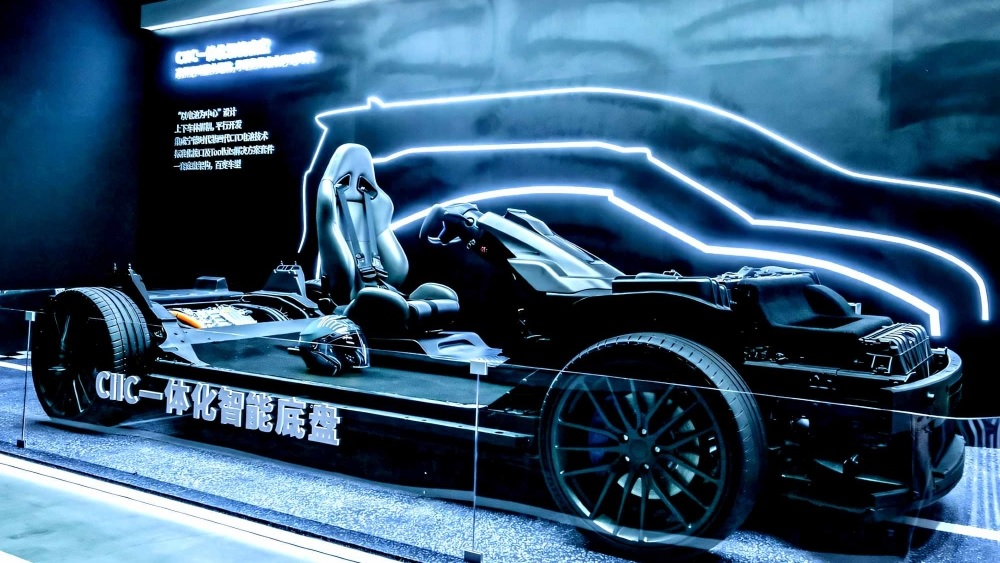
CATL has analyzed lithium metal batteries (LMB) to increase their energy density without compromising their service life.
The chemistry of electric car batteries is complex, with many factors coming into play that must be balanced to achieve batteries that offer both performance and durability. Lithium metal batteries (LMB) are seen by many as the next major breakthrough in this industry, but they have a significant problem related to the balance between these two factors.
Now CATL, the world’s largest battery manufacturer, has announced a new development, published in Nature Nanotechnology, to solve this problem, based on quantitative mapping of the batteries.
The problem with LMB batteries
According to CATL, this breakthrough makes it possible to “develop LMBs with high energy density and long service life, solving a long-standing challenge in this field. The optimized prototype has achieved a service life of 483 cycles and can be incorporated into cutting-edge designs to achieve an energy density of over 500 Wh/kg.”
LMBs stand out for their high energy density, which makes them the next-generation battery system for applications such as electric vehicles. However, the problem with them is that it is difficult to find a balance between this density and their service life.
To improve the former, something that has been attempted “by optimizing solvation structures and solid-electrolyte interfaces,” the trade-off is that their service life is compromised, making them commercially unviable. It is precisely this problem that the solution created by CATL addresses.
It is somewhat technical, which the company explains as follows: “A set of analytical techniques was developed and refined to track the evolution of active lithium and each electrolyte component throughout the battery’s life cycle. This approach transformed a ‘black box’ into a ‘white box’, revealing the critical pathways of depletion that cause cell failure.”
What was discovered is that, contrary to what was believed, the causes of cell failure are not those that were considered (solvent degradation, dead lithium accumulation, or alteration of the solvation environment), but rather the continuous consumption of the LiFSI electrolyte salt, which reaches 71% at the end of its useful life. The conclusion is that the focus must be placed on the durability of the electrolyte as a critical factor for continued battery performance.
Higher energy density and longer life cycle
But CATL not only identified the problem, it also came up with the solution. The brand has optimized the electrolyte formulation by introducing a lower molecular weight diluent. Thus, without increasing the mass of the electrolyte, its viscosity has been reduced and its conductivity improved, doubling its service life to 483 cycles and making it compatible with an energy density greater than 500 Wh/kg.
To put this into perspective, other avenues are being explored within the industry, the main one being solid-state batteries. A recent example is the batteries developed by Stellantis and Factorial, which have presented a model with an energy density of 375 Wh/kg, so this new format would exceed it by 33%.
Ouyang Chuying, co-president of Research and Development at CATL and deputy executive director of the 21C Laboratory, explains: “We saw a valuable opportunity to connect academic research with its practical application in commercial battery cells. Our findings underscore that LiFSI salt consumption and, above all, total salt concentration, are a determining factor in battery longevity.”
The price of the training is 250 euros.
The training is asynchronous online, you can do it at your own pace, whenever and from wherever you want, you set the schedule.
Classes are video recorded.
Start date: The training can be started whenever you want. Once payment is made, you have access to the training.
The training is in English, subtitles and syllabus avalaible.
Other subtitles and video syllabus available: Arabic, Chinese, French, German, Indonesian, Italian, Japanese, Korean, Persian, Portuguese, Russian, Spanish, Thai, Turkish, Vietnamese.
All syllabus has been developed by the teacher.
Fill out the following form to receive course information, or write an email to:
Contact.
- José Miguel Fernández Gómez.
- Email: info@advancedfleetmanagementconsulting.com
- Mobile phone: +34 678254874 Spain.
Course Features.
- The course is aimed at: managers, middle managers, fleet managers, any professional related to electric vehicles, and any company, organization, public administration that wants to switch to electric vehicles.
- Schedule: at your own pace, you set the schedule.
- Duration: 25 hours.
- Completion time: Once you have started the course you have 6 months to finish it.
- Materials: english slides and syllabus for each class in PDF.
- If you pass the course you get a certificate.
- Each class has a quiz to take.
- English language, subtitles and syllabus.
- Other subtitles and video syllabus available: Arabic, Chinese, French, German, Indonesian, Italian, Japanese, Korean, Persian, Portuguese, Russian, Spanish, Thai, Turkish, Vietnamese.
-
Start date: The course can be started whenever you want. Once payment is made, you have access to the course.
Price.
- 250 euros.
-
You can pay by bank transfer, credit card, or PayPal.
Goals.
- Know the most important aspects to take into account when electrifying a fleet of vehicles.
- Learn about electric vehicle technology.
- Know the polluting emissions that occur when a fleet of vehicles is electrified.
- Know what technologies are viable to electrify a fleet of vehicles.
- Learn about real cases of vehicle fleet electrification.
- Know the history of the electric vehicle.
Syllabus.
- History of electric vehicle.
- Battery electric vehicle.
- History of the lithium ion battery.
- Types of electric vehicle batteries.
- New electric vehicle battery materials.
- Other storage technologies of electric vehicle batteries.
- Battery components.
- Battery Management System-BMS.
- Fundamentals of the electric motor.
- Battery degradation loss of autonomy.
- What is covered and not covered by the electric vehicle battery warranty.
- Battery passport.
- Battery fire of the electric vehicle.
- Causes, stages and risks of battery fire.
- Real cases of electric vehicle fire.
- Electric vehicle battery fire extinguishment.
- Measures to prevent, extinguish and control electric vehicle fires.
- Fire safety regulations for electric vehicle batteries.
- Impact of ambient temperature on battery performance.
- Which emmits more Co2, an electric car or a car with an internal combustion engine.
- The use of rare earth earths in the electric vehicle.
- Plug-in electric hybrids, a solution or an obstacle to electrify the vehicle fleet?.
- Fleet electrification with hydrogen vehicles.
- Cybersecurity of charging points.
- The theft of copper in electric vehicle chargers.
- Incidents at electric car charging points and their possible solutions.
- Batery swapping.
- The tires of electric vehicles.
- Electric vehicle, artificial intelligence, and electricity demand.
- The case of Hertz electrification.
- The case of Huaneng: The world’s first electrified and autonomous mining fleet.
- Consequences on the vehicle fleet of an electric vehicle brand going bankruptcy.
- E-fuels and synthetic fuels are not an alternative to decarbonize the vehicle fleet.
- How to avoid premature obsolescence of the fleet’s electric vehicles.
- Polluting emissions from brakes.
- Mileage manipulation to extinguish warranty early on electric vehicles.
- The importance of the electricity tariff in reducing electric vehicle costs.
- Electric vehicles cause more motion sickness than gasoline vehicles.
Training teacher.
José Miguel Fernández Gómez is the manager of Advanced Fleet Management Consulting, a consulting company specialized in vehicle fleet management and the owner of the fleet management channel on YouTube AdvancedfleetmanagementTube.
Since 2007 I have been working in fleet management consultancy and training for all types of companies, organizations and public administrations. With this course I want to make my experience and knowledge acquired during my work and academic career in this discipline available to my clients.
I carry out consulting projects related to vehicle fleet management and collaborate with companies developing products/services in this market. I have worked at INSEAD (France), one of the best business schools in the world, as a Research Fellow at the Social Innovation Centre-Humanitarian Research Group.
I carried out consulting and research activities in a project for the United Nations refugee organization (UNHCR), optimizing the size and management of the activities of the vehicle fleet, which this organization has distributed throughout the world (6,500 vehicles).
I worked as a fleet manager for five years, for Urbaser, which managed the street cleaning service in Madrid (Spain). I managed a fleet of 1,000 vehicles, made up of various technologies and types of vehicles such as: heavy and light vehicles, vans, passenger cars or sweepers.
I have completed all my academic degrees at the Polytechnic University of Madrid, one of the best universities in Spain, my academic training is as follows:
I hold a PhD in Industrial Engineering, with international mention, since I carried out research stays at the University of Liverpool (UK) and at the Royal Institute of Technology-KTH (Sweden).
I am also an Industrial Engineer (Industrial Management) and an Mechanical Engineer, and I completed a Master’s Degree in Operations Management, Quality and Technological Innovation (Cepade) and another Master’s Degree in Industrial Management (UPM).
I have publications in indexed magazines and presentations at international industrial engineering conferences.
Cancellations and penalties.
Once the course has started, the amount will not be refunded.