The class develops car battery maintenance in winter and summer, and the implications for fleet management.
Slide 2. Car battery maintenance in winter and summer.
Proper battery function is essential for starting the engine, powering electrical systems, and ensuring safe driving. However, extreme temperatures, both in winter and summer, can shorten its life if certain precautions are not taken.
- What to do if the battery fails.
Despite all the care taken, no battery lasts forever. If you notice that the engine takes longer to start or the lights are dimmer, the battery is probably reaching the end of its life.
In that case, it is best to take it to a repair shop for a complete check-up. Sometimes the problem is not with the battery but with the alternator or faulty wiring.
In addition, having a good roadside assistance service can make all the difference if you break down.
- The impact of cold weather on the battery.
Winter is undoubtedly the most demanding season for a car battery. Low temperatures reduce the battery’s charging capacity and increase the viscosity of the engine oil, which means that the engine requires more energy to start. In addition, many drivers make greater use of the heating, windshield wipers, and lights, which increases electricity consumption.
To prevent the battery from discharging or breaking down in winter, it is advisable to take the following recommendations into account:
- Check the condition of the battery: If it is more than three years old, it is advisable to have it checked before winter at a specialist workshop.
- Avoid short journeys: Short journeys do not allow the alternator to fully recharge the battery, especially in low temperatures.
- Turn off electrical systems before starting: Lights, radio, heating, and other devices should be turned off when starting the engine to avoid unnecessary discharge.
- Use a battery maintainer: If the car is going to be stationary for several days, this device can help maintain the charge without damaging the battery.
- Heat also takes its toll.
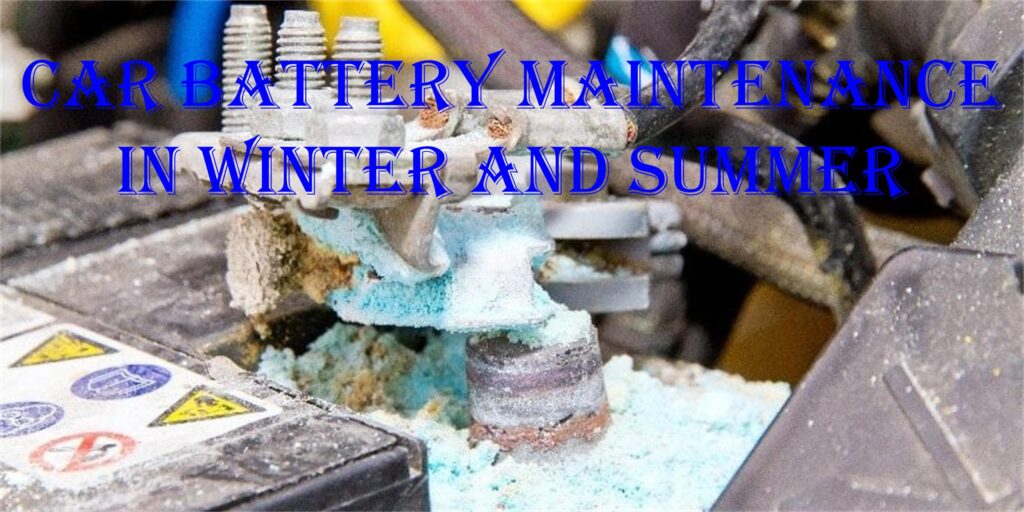
Although battery wear is usually associated with winter, summer heat can also seriously damage it. High temperatures accelerate the evaporation of the electrolyte inside the battery, which can cause overcharging or sulfation on the terminals.
During the hot months, it is essential to take these precautions:
- Avoid prolonged exposure to the sun: Whenever possible, park your car in the shade or in a garage. Excessive heat under the hood can raise the battery temperature to harmful levels.
- Check the electrolyte level: If your battery is not completely sealed, check that the levels are within the recommended range and top up with distilled water if necessary.
- Clean the terminals: Sulfate buildup can create electrical resistance that reduces charging efficiency. A wire brush and a little water with baking soda are usually enough to keep them clean.
- Check the alternator charging voltage: Excessive charging can overheat the battery. A mechanic can check that it is working properly.
- Problems with lead-acid batteries: sulfation and acid stratification.
If a battery is charged at too low a voltage, or if it always operates at too low a voltage, below 80%, acid stratification occurs. The acid in the electrolyte stratifies due to poor mixing. The different densities cause the sulfuric acid to stratify at the bottom of the battery and the water at the top. As a result, only the middle third of the electrolyte can be used for the charging and discharging process.
One possible cause of acid stratification is the predominance of short trips with the car, combined with the use of a large number of electrical consumers. If this is the case, the alternator does not have enough time to recharge the battery.
One of the consequences of acid stratification is sulfation. If this occurs in the battery, or if it is not constantly charged to a sufficient level, lead sulfate (PbSO4) crystallizes on the electrodes, forming larger crystal structures over time. This process is known as “sulfation.” Crystallization prevents lead sulfate from reverting to its original components, lead or lead dioxide, preventing charge acceptance and reducing cold cranking power.
On the other hand, sharp crystals can cause damage to the separators or short circuits in the cells.
To counteract this effect and prevent premature battery failure, the battery should never be kept at a low charge level for an extended period of time. To this end, it is advisable to check the battery frequently and charge it fully if necessary.
- General tips for extending battery life.
Regardless of the season, there are certain habits that will help you extend the life of your battery:
- Start the car regularly: Especially if you don’t use it often, starting the car once a week can prevent deep discharges.
- Don’t leave devices on with the engine off: Chargers, interior lights, or the sound system can drain the battery if used without the engine running.
- Perform regular maintenance on the electrical system: Make sure there are no parasitic loads or leaks that silently drain the battery.
- Replace the battery in time: An old or defective battery can leave you stranded at the worst possible moment. Don’t wait until it fails completely to replace it.
In short, the battery is a vital component of the vehicle, and both the cold of winter and the heat of summer can affect it negatively if preventive measures are not taken. With a few simple precautions, you can extend its life and avoid unpleasant surprises.
- Implications for fleet management.
The battery is one of the most important parts of the car and, often, one of the most overlooked. Ensuring that it works properly is essential for the vehicle to be available for service.
A car battery will eventually fail, sooner or later. Our goal is to make it last as long as possible and to replace it before it fails. To do this, we need to know when the battery is in poor condition.
It is recommended to check the battery every 3 months, and especially before the start of winter and summer.
When I worked as a fleet manager for the street cleaning service in Madrid, I had to replace one battery per car every year, which is a very high cost, as these were cars that were used intensively by many different drivers.
In addition to the cost of the battery, another drawback is the time that the vehicle is unavailable for service, and if it happens on the road, you have to call a tow truck.
In rental or leasing fleets, if the battery breaks down, the customer cannot use the vehicle they are paying for. In addition to the time during which the vehicle cannot be used, the customer has to call a tow truck, the rental or leasing company, etc., and it is likely that the customer will have to be provided with another car and reimbursed or compensated for the damage caused.
It is recommended to use Premium brand batteries, because in my experience, low-cost battery brands are used in fleets, which last much less than Premium batteries, and in the long term, the cost is higher and they break down more often.
Slide 3. Thank you for your time.
The class has developed car battery maintenance in winter and summer and the implications for fleet management, see you soon.
Bibliography.
https://www.autopista.es/noticias-motor/como-cuidar-bateria-coche-en-invierno-verano_311888_102.html
https://www.varta-automotive.com/es-es/knowledge/articles/article-details/funcion-de-bateria-de-coche
The price of the training is 250 euros.
The training is asynchronous online, you can do it at your own pace, whenever and from wherever you want, you set the schedule.
Classes are video recorded.
Start date: The training can be started whenever you want. Once payment is made, you have access to the training.
The training is in English, subtitles and syllabus avalaible.
Other subtitles and video syllabus available: Arabic, Chinese, French, German, Indonesian, Italian, Japanese, Korean, Persian, Portuguese, Russian, Spanish, Thai, Turkish, Vietnamese.
All syllabus has been developed by the teacher.
Fill out the following form to receive course information, or write an email to:
Contact.
- José Miguel Fernández Gómez.
- Email: info@advancedfleetmanagementconsulting.com
- Mobile phone: +34 678254874 Spain.
Course Features.
- The course is aimed at: managers, middle managers, fleet managers, any professional related to electric vehicles, and any company, organization, public administration that wants to switch to electric vehicles.
- Schedule: at your own pace, you set the schedule.
- Duration: 25 hours.
- Completion time: Once you have started the course you have 6 months to finish it.
- Materials: english slides and syllabus for each class in PDF.
- If you pass the course you get a certificate.
- Each class has a quiz to take.
- English language, subtitles and syllabus.
- Other subtitles and video syllabus available: Arabic, Chinese, French, German, Indonesian, Italian, Japanese, Korean, Persian, Portuguese, Russian, Spanish, Thai, Turkish, Vietnamese.
-
Start date: The course can be started whenever you want. Once payment is made, you have access to the course.
Price.
- 250 euros.
-
You can pay by bank transfer, credit card, or PayPal.
Goals.
- Know the most important aspects to take into account when electrifying a fleet of vehicles.
- Learn about electric vehicle technology.
- Know the polluting emissions that occur when a fleet of vehicles is electrified.
- Know what technologies are viable to electrify a fleet of vehicles.
- Learn about real cases of vehicle fleet electrification.
- Know the history of the electric vehicle.
Syllabus.
- History of electric vehicle.
- Battery electric vehicle.
- History of the lithium ion battery.
- Types of electric vehicle batteries.
- New electric vehicle battery materials.
- Other storage technologies of electric vehicle batteries.
- Battery components.
- Battery Management System-BMS.
- Fundamentals of the electric motor.
- Battery degradation loss of autonomy.
- What is covered and not covered by the electric vehicle battery warranty.
- Battery passport.
- Battery fire of the electric vehicle.
- Causes, stages and risks of battery fire.
- Real cases of electric vehicle fire.
- Electric vehicle battery fire extinguishment.
- Measures to prevent, extinguish and control electric vehicle fires.
- Fire safety regulations for electric vehicle batteries.
- Impact of ambient temperature on battery performance.
- Which emmits more Co2, an electric car or a car with an internal combustion engine.
- The use of rare earth earths in the electric vehicle.
- Plug-in electric hybrids, a solution or an obstacle to electrify the vehicle fleet?.
- Fleet electrification with hydrogen vehicles.
- Cybersecurity of charging points.
- The theft of copper in electric vehicle chargers.
- Incidents at electric car charging points and their possible solutions.
- Batery swapping.
- The tires of electric vehicles.
- Electric vehicle, artificial intelligence, and electricity demand.
- The case of Hertz electrification.
- The case of Huaneng: The world’s first electrified and autonomous mining fleet.
- Consequences on the vehicle fleet of an electric vehicle brand going bankruptcy.
- E-fuels and synthetic fuels are not an alternative to decarbonize the vehicle fleet.
- How to avoid premature obsolescence of the fleet’s electric vehicles.
- Polluting emissions from brakes.
- Mileage manipulation to extinguish warranty early on electric vehicles.
- The importance of the electricity tariff in reducing electric vehicle costs.
Training teacher.
José Miguel Fernández Gómez is the manager of Advanced Fleet Management Consulting, a consulting company specialized in vehicle fleet management and the owner of the fleet management channel on YouTube AdvancedfleetmanagementTube.
Since 2007 I have been working in fleet management consultancy and training for all types of companies, organizations and public administrations. With this course I want to make my experience and knowledge acquired during my work and academic career in this discipline available to my clients.
I carry out consulting projects related to vehicle fleet management and collaborate with companies developing products/services in this market. I have worked at INSEAD (France), one of the best business schools in the world, as a Research Fellow at the Social Innovation Centre-Humanitarian Research Group.
I carried out consulting and research activities in a project for the United Nations refugee organization (UNHCR), optimizing the size and management of the activities of the vehicle fleet, which this organization has distributed throughout the world (6,500 vehicles).
I worked as a fleet manager for five years, for Urbaser, which managed the street cleaning service in Madrid (Spain). I managed a fleet of 1,000 vehicles, made up of various technologies and types of vehicles such as: heavy and light vehicles, vans, passenger cars or sweepers.
I have completed all my academic degrees at the Polytechnic University of Madrid, one of the best universities in Spain, my academic training is as follows:
I hold a PhD in Industrial Engineering, with international mention, since I carried out research stays at the University of Liverpool (UK) and at the Royal Institute of Technology-KTH (Sweden).
I am also an Industrial Engineer (Industrial Management) and an Mechanical Engineer, and I completed a Master’s Degree in Operations Management, Quality and Technological Innovation (Cepade) and another Master’s Degree in Industrial Management (UPM).
I have publications in indexed magazines and presentations at international industrial engineering conferences.
Cancellations and penalties.
Once the course has started, the amount will not be refunded.