The price is 300 dollars.
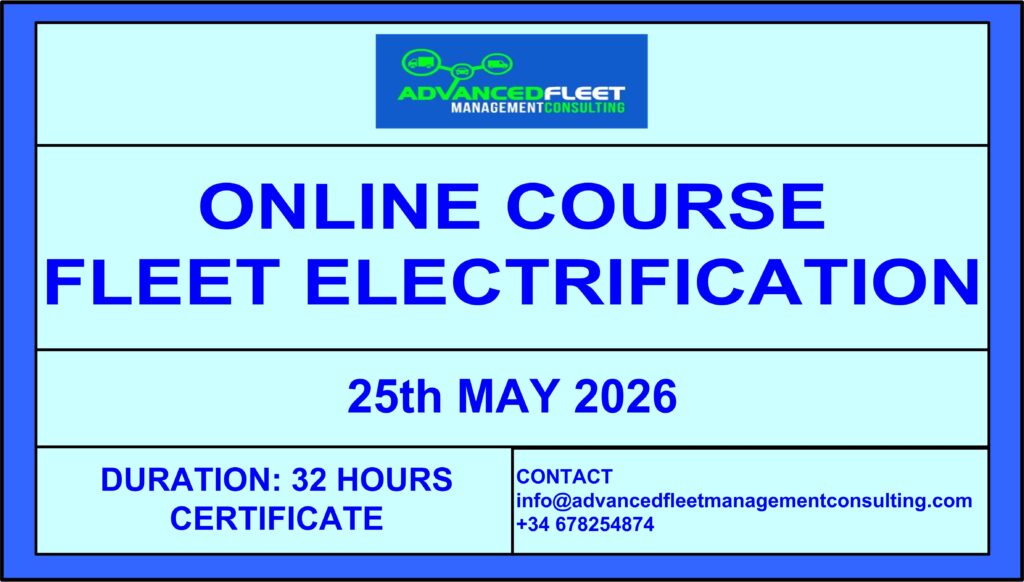
The training is asynchronous online, you can do it at your own pace, whenever and from wherever you want, you set the schedule.
Start date: 25th May 2026
The training is in English, subtitles and syllabus avalaible.
Other subtitles and video syllabus available: Arabic, Chinese, French, German, Indonesian, Italian, Japanese, Korean, Persian, Portuguese, Russian, Spanish, Thai, Turkish, Vietnamese.
All syllabus has been developed by the teacher.
Fill out the following form to receive course information, or write an email to:
Contact.
- José Miguel Fernández Gómez.
- Email: info@advancedfleetmanagementconsulting.com
- Mobile phone: +34 678254874 Spain.
Course Features.
- The course is aimed at: managers, middle managers, fleet managers, any professional related to electric vehicles, and any company, organization, public administration that wants to switch to electric vehicles.
- Schedule: at your own pace, you set the schedule.
- Duration: 32 hours.
- Start date: 25th May 2026
- Completion time: You have 6 months to finish it.
- Materials: english slides and syllabus for each class in PDF.
- If you pass the course you get a certificate.
- Each class has a quiz to take.
- English language, subtitles and syllabus.
- Tutorials: You can have an online tutorial with the teacher if you request it.
Price.
- 300$ dollars.
-
You can pay by bank transfer, credit card, or PayPal.
Goals.
- Know the most important aspects to take into account when electrifying a fleet of vehicles.
- Learn about electric vehicle technology.
- Know the polluting emissions that occur when a fleet of vehicles is electrified.
- Know what technologies are viable to electrify a fleet of vehicles.
- Learn about real cases of vehicle fleet electrification.
- Know the history of the electric vehicle.
Syllabus.
-
- Electric vehicle technology.
- History of the electric vehicle.
- Electric vehicle technology.
- Fundamentals of the electric vehicle battery.
- Other electric vehicle battery storage technologies.
- Electric vehicle battery components
- Battery Management System-BMS.
- Electric vehicle battery degradation.
- Battery degradation in plug-in hybrids
- The tipping point in electric vehicle battery degradation.
- The battery reserve of electric vehicles.
- Impact of ambient temperature on battery performance.
- Fundamentals of the electric vehicle motor.
- Types of electric motors and their relationship with rare earths.
- An electric vehicle inverter: What it is and what it is used for.
- The use of rare earths in electric vehicles.
- Electric vehicle tires.
- The brake-by-wire of electric vehicles.
- The electromagnetic fields of the electric vehicle.
-
- Electric vehicle battery.
- What is and is not covered by the electric vehicle battery warranty.
- The battery passport.
- A second life for electric vehicle batteries
-
- Electric vehicle battery fire.
- Prevention, control, and extinguishing of electric vehicle battery fires.
- Fire safety regulations for electric vehicle batteries.
-
- Charging Points: Problems and solutions.
- Problems with electric car charging points and their possible solutions
- Copper theft from electric vehicle chargers
- Cybersecurity at charging points
-
- Polluting emissions from electric vehicles.
- Which emits more CO2, an electric car or a car with an internal combustion engine?
- Polluting emissions from brakes
-
- Key aspects of fleet electrification.
- Fleet electrification with plug-in hybrids: Problem or solution?
- Fleet electrification with hydrogen vehicles.
- Battery swapping: A feasible solution for urban fleets.
- The Hertz electrification case.
- The Huaneng case, the world’s first electrified and autonomous mining fleet.
- A real-life taxi case: Three true stories of electrification for economic reasons.
- The second life of the electric vehicle battery at Rome-Fiumicino Leonardo Da Vinci Airport.
- Consequences for the vehicle fleet if an electric vehicle brand goes bankrupt.
- The electric vehicle brands most likely to break down due to high temperatures.
- How to avoid premature obsolescence of electric vehicles in the fleet.
- Mileage manipulation to void the warranty.
- E-fuels and synthetic fuels are not an alternative for decarbonizing the vehicle fleet.
- The importance of electricity tariffs in reducing electric vehicle costs.
- Electric vehicles, artificial intelligence, and electricity demand.
- The danger of electric vehicle door handles.
- The security issue with touchscreens.
-
- Electric vehicle insurance.
- The price of electric vehicle insurance.
- Electric vehicle insurance and advanced driver assistance systems (ADAS).
-
- Driving an electric vehicle.
- Electric vehicles cause more motion sickness than gasoline-powered vehicles.
- One-pedal driving: Risk of accidents.
- Driving an electric vehicle in flooding and torrential storms.
Training teacher.
José Miguel Fernández Gómez is the manager of Advanced Fleet Management Consulting, a consulting company specialized in vehicle fleet management and the owner of the fleet management channel on YouTube AdvancedfleetmanagementTube.
Since 2007 I have been working in fleet management consultancy and training for all types of companies, organizations and public administrations. With this course I want to make my experience and knowledge acquired during my work and academic career in this discipline available to my clients.
I carry out consulting projects related to vehicle fleet management and collaborate with companies developing products/services in this market. I have worked at INSEAD (France), one of the best business schools in the world, as a Research Fellow at the Social Innovation Centre-Humanitarian Research Group.
I carried out consulting and research activities in a project for the United Nations refugee organization (UNHCR), optimizing the size and management of the activities of the vehicle fleet, which this organization has distributed throughout the world (6,500 vehicles).
I worked as a fleet manager for five years, for Urbaser, which managed the street cleaning service in Madrid (Spain). I managed a fleet of 1,000 vehicles, made up of various technologies and types of vehicles such as: heavy and light vehicles, vans, passenger cars or sweepers.
I have completed all my academic degrees at the Polytechnic University of Madrid, one of the best universities in Spain, my academic training is as follows:
I hold a PhD in Industrial Engineering, with international mention, since I carried out research stays at the University of Liverpool (UK) and at the Royal Institute of Technology-KTH (Sweden).
I am also an Industrial Engineer (Industrial Management) and an Mechanical Engineer, and I completed a Master’s Degree in Operations Management, Quality and Technological Innovation (Cepade) and another Master’s Degree in Industrial Management (UPM).
I have publications in indexed magazines and presentations at international industrial engineering conferences.
Cancellations and penalties.
Once the course has started, the amount will not be refunded.